Social ScienceClass 7

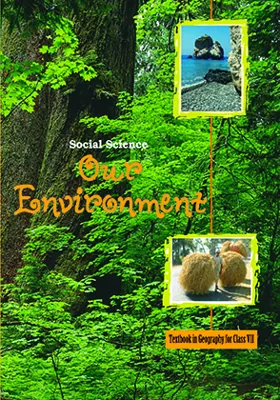
Our Environment

Geography7 Chapters

Chapter notes

What you'll learn in Our Environment

A quick revision map of Our Environment — the core idea and five key takeaways from each chapter. Tap any chapter to read the full NCERT PDF and detailed notes.

01

Environment

Environment is the place, people, things and nature that surround any living organism; it is a combination of natural phenomena (biotic and abiotic) and human-made phenomena such as roads, buildings and factories.

  • 1Environment is a combination of natural and human-made phenomena; the word comes from the French 'Environer/Environner' meaning 'neighbourhood'.
  • 2The natural environment has four domains: lithosphere (solid earth crust), hydrosphere (all water bodies), atmosphere (layer of air around the earth), and biosphere (narrow zone where land, water and air interact to support life).
  • 3Lithosphere is the hard top layer of the earth made of rocks and minerals covered by soil; it provides forests, grasslands, agricultural land and is a source of mineral wealth.
  • 4The atmosphere is held by Earth's gravitational force, protects us from the sun's harmful rays, consists of gases, dust and water vapour, and its changes produce changes in weather and climate.
  • 5Biotic refers to the world of living organisms such as plants and animals; abiotic refers to the world of non-living elements such as land.
02

Inside Our Earth

The earth's interior has three concentric layers — crust (thinnest), mantle, and core — and its crust is composed of three types of rocks: igneous, sedimentary, and metamorphic, which continuously transform through the rock cycle.

  • 1Earth has three layers: crust (1% of volume), mantle (84%), and core (15%); the crust is the thinnest at about 35 km on continents and 5 km on ocean floors.
  • 2Continental crust is called sial (silica + alumina); oceanic crust is called sima (silica + magnesium).
  • 3The innermost core has a radius of about 3500 km and is made of nickel and iron, hence called nife.
  • 4Three types of rocks: igneous (from cooled magma, also called primary rocks), sedimentary (from compressed sediments), and metamorphic (under heat and pressure).
  • 5Extrusive igneous rocks (e.g., basalt) form on the surface and have fine grains; intrusive igneous rocks (e.g., granite) cool slowly deep inside and have large grains.
03

Our Changing Earth

Chapter 3 'Our Changing Earth' explains how lithospheric plates move a few millimetres each year due to molten magma, triggering endogenic forces such as earthquakes and volcanoes, while exogenic forces — rivers, sea waves, glaciers, and wind — continuously erode and deposit material to build new landforms.

  • 1Lithospheric plates move a few millimetres each year because molten magma inside the earth moves in a circular manner.
  • 2Endogenic forces originate inside the earth — sudden forces include earthquakes and volcanoes; diastrophic forces build mountains.
  • 3Exogenic forces act on the earth's surface through erosion (by water, wind, and ice) and subsequent deposition to create landforms.
  • 4An earthquake's point of origin in the crust is the focus; the point directly above it on the surface is the epicentre. The three types of earthquake waves are P waves (longitudinal), S waves (transverse), and L waves (surface).
  • 5Earthquakes are measured using a seismograph; magnitude is read on the Richter scale — over 5.0 causes damage, 6.0+ is very strong, and 7.0 is a major earthquake.
04

Air

The atmosphere is a huge blanket of air surrounding the earth, composed mainly of nitrogen and oxygen, divided into five layers — Troposphere, Stratosphere, Mesosphere, Thermosphere, and Exosphere — and essential for all weather, climate, and life on earth.

  • 1Nitrogen is the most plentiful gas in the atmosphere; plants cannot absorb it directly — soil bacteria convert it into a usable form.
  • 2The atmosphere has five layers: Troposphere (13 km average, all weather here), Stratosphere (up to 50 km, ozone layer, best for aircraft), Mesosphere (up to 80 km, meteorites burn here), Thermosphere (80–400 km, radio waves reflect here), and Exosphere (outermost, very thin).
  • 3Carbon dioxide creates the greenhouse effect by trapping heat; rising CO2 from burning fuels causes global warming, which melts polar ice and raises sea levels, causing coastal floods.
  • 4Insolation (incoming solar energy intercepted by the earth) decreases from the equator towards the poles, explaining why temperature falls the same way and poles remain snow-covered.
  • 5Air pressure is highest at sea level and decreases with height; high temperature creates low pressure (cloudy, wet weather) and low temperature creates high pressure (clear, sunny skies).
05

Water

Chapter 5 of Class 7 Our Environment explains how water moves through the water cycle and how it is distributed across Earth, then explores the three movements of ocean water — waves, tides, and ocean currents.

  • 1The water cycle is the process by which water continually changes its form and circulates between oceans, atmosphere, and land.
  • 2Oceans contain 97.3% of Earth's total water (saline); ice caps hold 2.0%, ground water 0.68%, and rivers just 0.0001% of all water.
  • 3Average ocean salinity is 35 parts per thousand; the Dead Sea in Israel has salinity of 340 grams per litre, so dense that swimmers float in it.
  • 4Waves form when winds scrape across the ocean surface; a tsunami is a huge wave up to 15 m high caused by an earthquake, volcanic eruption, or underwater landslide.
  • 5The 2004 Indian Ocean tsunami (epicentre near Sumatra, magnitude 9.0) killed more than 10,000 people and completely submerged Indira Point in the Andaman and Nicobar Islands.
06

Life in the Deserts

Chapter 6 of NCERT Class 7 Our Environment covers two types of deserts — the hot Sahara in North Africa and the cold desert of Ladakh in the Himalayas — comparing their climates, flora, fauna, and the lives of people who inhabit them.

  • 1Sahara is the world's largest desert at 8.54 million sq km, spanning eleven North African countries including Algeria, Chad, Egypt, Libya and Morocco.
  • 2Sahara days can reach 50°C while nights drop near 0°C; Al Azizia in Libya recorded 57.7°C in 1922, the highest temperature noted in the text.
  • 3Bedouins and Tuaregs are nomadic tribes of the Sahara who rear camels, goats, sheep and horses, using hides for leather goods and hair for mats and blankets.
  • 4Oil found in Algeria, Libya and Egypt is transforming the Sahara; other minerals in the region include iron, phosphorus, manganese and uranium.
  • 5Ladakh is a cold desert enclosed by the Karakoram Range in the north and the Zanskar mountains in the south, with the Indus as its most important river.
07

Human Environment Interactions

Chapter 7 of NCERT Class 7 Geography 'Our Environment' examines human-environment interactions in two major basins — the Amazon Basin in equatorial South America and the Ganga-Brahmaputra Basin in the subtropical Indian subcontinent — showing how climate and landforms shape livelihoods, food, and shelter.

  • 1The Amazon Basin is the largest river basin in the world, in the equatorial region (10°N–10°S), draining parts of Brazil, Peru, Bolivia, Ecuador, Colombia, and a small part of Venezuela.
  • 2Amazon's hot, wet climate produces dense rainforests where the leaf-and-branch canopy blocks sunlight from the ground; notable wildlife includes toucans, macaws, piranha, anacondas, tapirs, and sloth.
  • 3Amazon people practise slash-and-burn agriculture; their staple is manioc (cassava); homes range from thatched beehive-shaped huts to large Maloca houses with steeply slanting roofs.
  • 4The Trans-Amazon Highway (1970) made the rainforest accessible, displaced indigenous communities, and accelerated deforestation; when forest cover is lost, topsoil is washed away by rain.
  • 5The Ganga-Brahmaputra Basin lies in the subtropical region (10°N–30°N); its fertile plains support paddy (main crop), wheat, sugarcane, jute, tea (West Bengal and Assam), and silk (Bihar and Assam).

More Social Science books

Want offline access with notes & solutions?

Download CBSE Prepmaster for free — includes NCERT solutions, flashcards, mock tests & more.

Download Free App