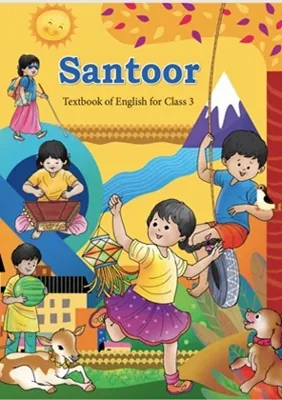
EnglishClass 3

Santoor

English Textbook12 Chapters

Chapter notes

What you'll learn in Santoor

A quick revision map of Santoor — the core idea and five key takeaways from each chapter. Tap any chapter to read the full NCERT PDF and detailed notes.

01

Colours

Chapter 1 of the Class 3 English NCERT textbook (Santoor), "Colours", teaches children about colours through a short poem about sharing crayons, and builds English language skills through consonant blends, action words, the alphabet, and compound word activities.

  • 1The chapter poem shows two children sharing their crayons to make a full pack of colours: red, yellow, blue, green, purple, and black.
  • 2Children answer comprehension questions about why the children share and how many children appear in the poem.
  • 3The chapter teaches consonant blends gr, cr, dr, and pr through colour and everyday words said aloud.
  • 4A fun colour-reading activity asks children to read the colour of the ink, not the word written, to build attention and focus.
  • 5Action words (verbs) are introduced; children circle them from a mixed list and locate them in a word-search grid.
02

Badal and Moti

Chapter 2 of the Class 3 English NCERT textbook (Santoor), "Badal and Moti", tells the story of a village boy named Badal who rescues a shivering puppy, names it Moti, and is later saved by Moti when he falls into a deep pit on a rainy day.

  • 1Badal found a shivering puppy on his way home from school and brought it home.
  • 2Badal's mother allowed him to keep the puppy only after he promised to take care of it.
  • 3Badal and his mother named the puppy Moti, and the two became best friends.
  • 4On a rainy day, Badal slipped on a muddy lane and fell into a deep pit and could not get out.
  • 5Moti caught Badal's scent and led the neighbours to the pit by barking, and they pulled Badal out with a rope.
03

Best Friends

Chapter 3 of the Class 3 English NCERT textbook (Santoor), "Best Friends", tells the story of four shape friends — Circle, Square, Triangle, and Rectangle — who quarrel over who is the best, until a wise star teaches them that working together is more powerful than competing.

  • 1Circle says it is the best because it is round, has no sharp edges, and is used to draw a smiling face.
  • 2Square claims to be the best because it has four equal sides and many sweets are square-shaped.
  • 3Triangle argues it is best because it has three sides and children use it to draw mountains.
  • 4Rectangle says it is best because it has two long and two short sides, and biscuits and chocolates come in rectangle shape.
  • 5The shapes cannot decide who is best and ask the first person they meet, who turns out to be a star.
04

Out in the Garden

Chapter 4 of the Class 3 English NCERT textbook (Santoor), "Out in the Garden", is a poem about a child playing outdoors in a garden each fine day, describing activities with a ball and a kite and playing with friends, followed by comprehension questions, a grammar exercise on joining words with "and", and a hands-on paper bag puppet craft activity.

  • 1The poem is set in a garden where a child plays each fine day with a ball, a kite, and friends.
  • 2Ball actions in the poem: bounce, throw, and catch.
  • 3Kite actions in the poem: tug, pull, and fly.
  • 4Playing with friends involves running, skipping, jumping, swaying, sliding, and swinging.
  • 5New vocabulary words introduced are bounce, throw, slide, and sway.
05

Talking Toys

Chapter 5 of the Class 3 English NCERT textbook (Santoor), "Talking Toys", tells the story of a busy toy shop on a holiday where the toys eagerly watch as different customers come in and choose toys like a Vande Bharat train, a toy aeroplane, marbles, a spinning top, dancing dolls, and a toy elephant, while also teaching children describing words (adjectives), plural forms of nouns, a poem about a spinning top, and a hands-on activity for making jute or cardboard puppets.

  • 1The story is set in a busy local toy shop on a holiday that opens at 9 a.m.
  • 2Toys in the shop include wooden toys, soft toys, board games, bats, balls, a talking doll, toy elephant, toy aeroplane, toy phone, marbles, spinning top, and Kondapalli dancing dolls.
  • 3A little boy asks his mother (calling her 'Aayi') to buy him a Vande Bharat toy train, and she does.
  • 4Students learn that describing words like 'happy', 'red', 'talking', and 'blue' tell us more about naming words.
  • 5Plural nouns are formed by adding 's' to most words and 'es' to words like box, class, bus, and brush.
06

Paper Boats

Chapter 6 of the Class 3 English NCERT textbook (Santoor), "Paper Boats", tells the story of a girl named Meena who floats paper boats in a stream near a bamboo bridge, gets upset when a naughty boy starts overturning them, and then teaches the boy how to fold paper boats so they can both enjoy playing together.

  • 1Meena floats paper boats in a stream near a bamboo bridge and feels delighted watching them sail.
  • 2A naughty boy starts overturning her boats for fun, making Meena angry.
  • 3Meena tells the boy firmly to stop, and the boy agrees and asks if he can join in.
  • 4Meena has enough coloured paper of different sizes and teaches the boy how to fold and re-fold paper to make boats.
  • 5After learning, the boy makes his own boats and both children float them together and enjoy watching them sail.
07

The Big Laddoo

Chapter 7 of the Class 3 English NCERT textbook (Santoor), "The Big Laddoo", is a fun poem that uses the idea of imagining everything in the world combined into one gigantic thing — one laddoo, one child, one sea — and then pictures the big child throwing the big laddoo into the big sea with a big splish-splash.

  • 1The poem imagines all laddoos combined into one Big Laddoo, all children into one Big Child, and all seas into one Big Sea.
  • 2The Big Child throws the Big Laddoo into the Big Sea, making a big splish-splash — a playful, imaginative ending.
  • 3New words introduced in the poem are sea and splish-splash.
  • 4A story about Jithu and Meena, who is visually impaired, teaches children about how we can identify things by touch.
  • 5Children practise writing sentences using consonant blends: cl (clock, cloud), pl (play, plum), and bl (blue, blanket).
08

Thank God

Chapter 8 of the Class 3 English NCERT textbook (Santoor), "Thank God", is a Jataka tale about a wise farmer who brings grapes as a gift to the king, and cleverly thanks God when the king throws grapes at him — because he had considered bringing the much heavier watermelons instead.

  • 1The story is a Jataka tale about a kind and wise farmer who grew a variety of fruits, including grapes and watermelons.
  • 2The farmer chose to gift grapes to the king instead of watermelons because watermelons were too heavy for the long journey.
  • 3When the King threw grapes playfully at the farmer, the farmer said 'Thank God!' and called himself blessed.
  • 4The farmer explained his 'Thank God' reaction by pointing out that he could have brought the heavy watermelons instead, showing quick thinking.
  • 5The chapter introduces new words such as journey, guard, royal, and popped, and sight words such as grow, kept, front, again, and wise.
09

Madhu's Wish

Chapter 9 of the Class 3 English NCERT textbook (Santoor), "Madhu's Wish", is a story written by Sudha Murty about a food-loving boy named Madhu who shares his lunch with an old man and is granted a magical wish from a banyan tree, only to learn through hiccups and desperation that water is more important than any food.

  • 1Madhu loves food and eats his lunch every day under a banyan tree.
  • 2He shares his meal with a poor old man, who gives him a magical wish from the banyan tree.
  • 3Madhu wishes for different kinds of food including laddoos, fruits like mangoes, grapes, and bananas, and savouries like samosas, kachori, and potato chips.
  • 4A basket full of each food appears instantly, but when Madhu gets hiccups, he finds there is no water anywhere.
  • 5Drinks like sharbat, kheer, and badam milk do not stop the hiccups, and he finally prays to the tree to take all the food away and give him water.
10

Night

Chapter 10 of the Class 3 English NCERT textbook (Santoor), "Night", is a short poem that describes the daily journey of the Sun — shining all day, sinking behind a distant hill at night, and rising again in the morning — and pairs the poem with vocabulary, comprehension questions, a classroom observation activity, consonant blend phonics practice (sp, st, sk), and word-building exercises using "Sun".

  • 1The poem Night describes the Sun shining all day, sinking behind a distant hill, and rising again after the child sleeps.
  • 2New vocabulary words in the chapter are wonder, distant, and peep.
  • 3Children answer comprehension questions about what the Sun does at night and which things (sunflower, plants, children) need the Sun.
  • 4The chapter introduces consonant blends sp, st, and sk with word lists and pronunciation practice.
  • 5An I Spy classroom game encourages children to observe objects around them and describe them using colour clues.
11

Chanda Mama Counts the Stars

Chapter 11 of the Class 3 English NCERT textbook (Santoor), "Chanda Mama Counts the Stars", is a short story about the Moon (Chanda Mama) who tries night after night to count all the stars in the sky but keeps falling asleep and forgetting his count, until the Sun cheers him up by saying the number of stars equals the number of lovely children on Earth.

  • 1Chanda Mama (the Moon) tries to count all the stars but keeps falling asleep and forgetting his count.
  • 2The Sun helps Chanda Mama by telling him the number of stars equals the number of lovely children on Earth.
  • 3After hearing the Sun's answer, Chanda Mama smiles happily every night looking at the stars and the children.
  • 4The chapter introduces the location words 'here' (for things nearby) and 'there' (for things far away).
  • 5Children practise sorting things into 'can be counted easily' and 'too many to be counted' through a listening activity.
12

Chandrayaan

Chapter 12 of the Class 3 English NCERT textbook (Santoor), "Chandrayaan", tells the story of a curious girl named Rani who learns about India's Chandrayaan mission — launched on 14 July 2023 and landed on the Moon on 23 August 2023 — through a conversation with a scientist named Nandini Aunty, while also teaching the grammar rules for using 'a' and 'an'.

  • 1Chandrayaan means Moon vehicle — Chandra means Moon and Yaan means vehicle
  • 2India launched Chandrayaan on 14 July 2023 and it landed on the Moon on 23 August 2023
  • 3A rocket is the vehicle used to reach the Moon
  • 4Rani learns about Chandrayaan from Nandini Aunty, a scientist and mother of her brother's friend Vivaan
  • 5Use 'a' before singular nouns starting with consonants, and 'an' before singular nouns starting with vowel sounds

Want offline access with notes & solutions?

Download CBSE Prepmaster for free — includes NCERT solutions, flashcards, mock tests & more.

Download Free App