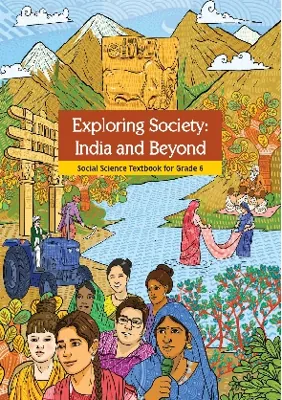
Social ScienceClass 6

Exploring Society: India and Beyond

Social Science Textbook14 Chapters

Chapter notes

What you'll learn in Exploring Society: India and Beyond

A quick revision map of Exploring Society: India and Beyond — the core idea and five key takeaways from each chapter. Tap any chapter to read the full NCERT PDF and detailed notes.

01

Locating Places on the Earth

Chapter 1 of Class 6 Exploring Society: India and Beyond teaches students how to locate any place on Earth using maps, latitudes, and longitudes. It covers how maps work, the coordinate grid of latitudes and longitudes, and how longitude determines time zones and standard time.

  • 1A map is a top-down representation or drawing of an area — small (a village) or large (the whole world); an atlas is a collection of maps.
  • 2The three main components of maps are distance (scale), direction (cardinal and intermediate points), and symbols.
  • 3Maps come in three main types: physical maps (show natural features like mountains and rivers), political maps (show countries, states, and boundaries), and thematic maps (show specific information).
  • 4Latitudes are imaginary lines running east to west, parallel to the Equator; the Equator is 0°, the North Pole is 90°N, and the South Pole is 90°S.
  • 5Longitudes are half-circles (meridians) running from pole to pole; the Prime Meridian passes through Greenwich in London and is marked 0°, established as the international standard in 1884.
02

Oceans and Continents

This chapter introduces oceans and continents — the vast water bodies and large landmasses that make up Earth's surface. It explains their names, sizes, distribution across hemispheres, the marine life they support, ocean-related disasters like tsunamis and cyclones, and the critical role oceans play in climate, oxygen production, and human life.

  • 1Almost three-fourths of Earth's surface is covered by water; land covers a little over one-fourth. Earth looks mostly blue from space and is called the 'blue planet.'
  • 2There are five oceans: Pacific (largest), Atlantic (second), Indian (third), Southern (fourth), and Arctic (smallest). Their dividing lines on maps are conventions — the oceans are naturally interconnected.
  • 3The Northern Hemisphere holds more land than the Southern Hemisphere; oceans and continents are not distributed equally between the two hemispheres.
  • 4Oceans support rich marine life: flora includes algae and seaweeds; fauna includes thousands of species of fish, dolphins, whales, and deep-sea creatures.
  • 5Seawater is salty and unfit for consumption. Freshwater makes up only a very small proportion of the planet's water and is found in glaciers, rivers, lakes, the atmosphere, and underground.
03

Landforms and Life

This chapter introduces the three major landforms — mountains, plateaus and plains — explaining how each is formed, what environments they support, and how people have adapted their lives, occupations and cultures to each landform.

  • 1Landforms are broadly divided into three types: mountains, plateaus and plains; each has different physical features, climates and environments.
  • 2Mountains have a broad base, steep slopes and a narrow summit; hills are similar but lower with rounded tops. Young mountains like the Himalayas are tall and sharp; older ones like the Aravallis are rounded by erosion.
  • 3Major mountain ranges include the Himalayas (Asia), the Alps (Europe) and the Andes (South America). Anamudi in Kerala is the highest mountain in south India.
  • 4Mountain slopes support montane forests of conifers (pines, firs, spruce, deodar); wildlife includes the yak, snow leopard, ibex, golden eagle and Himalayan tahr. People practice terrace farming, herding and tourism; challenges include landslides, avalanches, flash floods and heavy snowfall.
  • 5Plateaus rise from the surrounding land with a flat surface and are rich in mineral deposits, often called 'storehouses of minerals'. The Chhota Nagpur Plateau has iron, coal and manganese; the Tibetan Plateau (average altitude 4,500 m) is nicknamed the 'Roof of the World'.
04

Timeline and Sources of History

Chapter 4 of Exploring Society: India and Beyond teaches Class 6 students how historians measure time using BCE/CE and timelines, what the main sources of history are, and how early humans lived as hunters and gatherers before gradually settling down and farming.

  • 1History is defined as the study of the human past; the chapter opens with E.H. Carr's quote that history is 'an unending dialogue between the present and the past.'
  • 2The Gregorian calendar uses CE (Common Era, formerly AD) for years after Jesus' conventional birth date and BCE (Before Common Era, formerly BC) for years before it; there is no year zero, so to find the gap between a BCE and a CE date you add the two numbers and subtract 1.
  • 3A century is any period of 100 years and a millennium is any period of 1,000 years; we are currently in the 21st century CE and the 3rd millennium CE.
  • 4A timeline is a tool that shows a sequence of dates and events, helping students see the order in which things happened — for example, the Buddha's birth (560 BCE) comes before Jesus' birth.
  • 5Four types of scholars uncover the past: geologists (study Earth's physical features), palaeontologists (study fossils), anthropologists (study human societies and cultures), and archaeologists (dig up tools, pots, bones and other remains).
05

India, That is Bharat

This chapter explores the many names India has been known by throughout history — names given by ancient Indians such as 'Sapta Sindhava', 'Jambudvipa', and 'Bharatavarsha', as well as names used by foreign visitors like the Persians ('Hind'/'Hindu'), Greeks ('Indoi'), and Chinese ('Yindu') — all tracing back to the word 'Sindhu' (the Indus River).

  • 1The Rig Veda, India's most ancient text, called the northwest of the Subcontinent 'Sapta Sindhava', meaning the 'land of the seven rivers', from the word 'Sindhu' (the Indus River).
  • 2The Mahabharata lists many regions across the Subcontinent — such as Kashmira, Kurukshetra, Vanga, Pragjyotisha, Kaccha, and Kerala — and uses the names 'Bharatavarsha' and 'Jambudvipa' for the whole Subcontinent.
  • 3'Bharatavarsha' means 'the country of the Bharatas'; 'Jambudvipa' means 'the island of the fruit of the jamun tree', a tree native to India also called the jambul or Malabar plum tree.
  • 4Emperor Ashoka (around 250 BCE) used 'Jambudvipa' to describe all of India, which at that time included present-day Bangladesh, Pakistan, and parts of Afghanistan.
  • 5The Vishnu Purana defines 'Bharat' as 'the country that lies north of the ocean and south of the snowy mountains'; this name is used across India today — 'Bharat' in the north and 'Bharatam' in the south.
06

The Beginnings of Indian Civilisation

This chapter introduces the earliest civilisation of the Indian Subcontinent — the Harappan or Indus-Sarasvati Civilisation (about 2600–1900 BCE) — covering its town-planning, water management, trade, food, crafts, and eventual decline.

  • 1A civilisation is defined here as having government, urbanism, crafts, internal and external trade, a writing system, cultural expression, and productive agriculture.
  • 2The Harappan or Indus-Sarasvati Civilisation lasted roughly from 2600 to 1900 BCE and is one of the oldest civilisations in the world.
  • 3Cities were built on precise plans with wide streets (often oriented to the cardinal directions), fortifications, an upper town for the elite and a lower town for common people — all buildings made of bricks.
  • 4Water management was advanced: Mohenjo-daro had hundreds of brick-lined wells; Dholavira had at least six large reservoirs (the largest 73 metres long) connected by underground drains.
  • 5The Harappans were the first in Eurasia to grow cotton and cultivated barley, wheat, millets, rice and pulses; their diet also included dairy products, turmeric, ginger and banana.
07

India's Cultural Roots

Chapter 7 'India's Cultural Roots' explores the ancient foundations of Indian culture — from the four Vedas and Vedic schools of thought (Upanishads, Vedanta, Yoga) to Buddhism and Jainism, and India's rich folk and tribal traditions. It shows how these diverse belief systems, though different in many ways, share key concepts such as dharma, karma, ahimsa, and the search to end suffering and ignorance.

  • 1There are four Vedas — the Rig Veda, Yajur Veda, Sama Veda and Atharva Veda — India's most ancient texts, composed as hymns and transmitted orally for hundreds of generations.
  • 2In 2008, UNESCO recognised Vedic chanting as 'a masterpiece of the oral and intangible heritage of humanity' because these hymns were preserved in memory with hardly any alteration over thousands of years.
  • 3The Upanishads introduced key concepts such as brahman (the divine essence underlying everything), ātman (the self or soul within every being), karma (actions and their results), and rebirth.
  • 4Prince Siddhartha Gautama attained enlightenment under a pipal tree at Bodh Gaya (Bihar) and became the Buddha — meaning the 'enlightened' or 'awakened' one — teaching ahimsa (non-hurting) and inner discipline.
  • 5Mahavira, the key teacher of Jainism, was born near Vaishali (Bihar) and taught three central principles: ahimsa (non-violence toward all living beings), anekāntavāda (truth has many aspects), and aparigraha (non-possession).
08

Unity in Diversity, or Many in the One

Chapter 8 of Exploring Society: India and Beyond (Class 6 Social Science) explores 'unity in diversity' — how India's enormous variety in food, clothing, festivals, and literature all share common threads that bind the country together.

  • 1India has over 1.4 billion inhabitants (about 18% of the world's population) and the 'People of India' project surveyed 4,635 communities and counted 325 languages written in 25 scripts.
  • 2Common staple grains — cereals like rice, barley, and wheat; millets like bajra, jowar, and ragi; and pulses like various dals and rajma — are used throughout India, showing unity even in food diversity.
  • 3Common spices such as turmeric, cumin, cardamom, and ginger are used across the whole country.
  • 4The sari, a single unstitched length of cloth, is worn across most of India in hundreds of varieties (Banarasi, Kanjivaram, Paithani, Patan Patola, Muga, Mysore silk saris, plus many cotton kinds); India also exported a printed cotton called 'chintz' that became so popular in 17th-century Europe that England and France eventually banned its import.
  • 5Makara Sankranti, a harvest festival celebrated on or around 14 January, is observed across India under different names — Pongal, Lohri, Magh Bihu, Uttarayan, Khichdi Parv, and others — showing one celebration expressed many ways.
09

Family and Community

Chapter 9 of Class 6 Exploring Society: India and Beyond is about family and community — the two most basic units of society. It explains different types of families, the values and responsibilities that hold them together, and how communities support one another through shared traditions and cooperation.

  • 1There are two main types of families in India: joint families, where several generations live together, and nuclear families, which consist of a couple and their children (or sometimes one parent and children).
  • 2Most Indian languages have many specific words for family relationships — such as bua, tau, chacha, mausi, nana, nani in Hindi — whereas English uses far fewer terms. In most Indian languages there is no separate word for 'cousin' because cousins are considered brothers and sisters.
  • 3Family relationships are based on love, care, cooperation and interdependence. As children grow, they take on more responsibilities and also learn traditions that have been followed for generations.
  • 4The family acts as a 'school' where children learn important values: ahimsa, dāna (giving), sevā (service) and tyāga (sacrifice). Following one's dharma — doing one's duty — is an important principle of Indian culture.
  • 5Community is a group of connected people who come together for festivals, weddings, agricultural practices and mutual support. Communities also agree on rules for shared natural resources such as water, grazing lands and forest produce.
10

Grassroots Democracy Part 1: Governance

This chapter introduces Class 6 students to governance and democracy — explaining what governance is, why we need government, how its three organs (legislature, executive, judiciary) work, and what democracy means.

  • 1Governance is the process of taking decisions, organising society's life with different sets of rules, and ensuring those rules are followed.
  • 2The three organs of government are: the Legislature (makes laws), the Executive (implements laws), and the Judiciary (decides whether laws have been broken and what action to take).
  • 3The separation of powers keeps the three organs distinct and provides a system of checks and balances so no single organ can act beyond its expected role.
  • 4In India, government works at three levels — Local, State, and Central/Union — and different problems are handled at different levels depending on their scale.
  • 5The word 'democracy' comes from the Greek words 'dēmos' (people) and 'kratos' (rule or power), meaning the 'rule of the people'.
11

Grassroots Democracy Part 2: Local Government in Rural Areas

This chapter explains how local government works in rural India through the Panchayati Raj system — a three-tier structure of Gram Panchayat, Panchayat Samiti, and Zila Parishad that allows villagers to manage their own affairs and take part in decisions that affect their daily lives.

  • 1The Panchayati Raj system is a three-tier structure: Gram Panchayat at the village level, Panchayat Samiti/Block Panchayat at the block level, and Zila Parishad/District Panchayat at the district level.
  • 2The Gram Sabha — a group of adult voters from a village or nearby villages — elects the Gram Panchayat members and its head, called the Sarpanch or Pradhan.
  • 3The Gram Panchayat is supported by a Panchayat Secretary (who calls meetings and keeps records) and a Patwari (who maintains land records, sometimes including generations-old maps).
  • 4One-third of seats across all three tiers are reserved for women, and special rules ensure that disadvantaged sections of society can also have their needs heard.
  • 5The Panchayat Samiti links Gram Panchayats to the Zila Parishad, collects development plans, and helps channel funds for schemes like the Pradhan Mantri Gram Sadak Yojana, which promotes all-weather roads in rural areas.
12

Grassroots Democracy Part 3: Local Government in Urban Areas

This chapter explains how urban local bodies — the local governments of India's cities and towns — work to manage everyday services and involve citizens in decision-making. It covers the types of urban local bodies, their functions, and why active citizen participation is essential to make them effective.

  • 1Urban areas are governed by 'urban local bodies' — decentralised structures where local communities have a direct say in how their areas are managed.
  • 2Cities and towns are divided into smaller units called wards; ward committees handle local activities and report problems like water leaks, blocked drains, and damaged roads.
  • 3Urban local bodies are responsible for infrastructure, garbage collection and disposal, maintaining burial grounds, collecting local taxes and fines, and planning for economic and social development.
  • 4Cities with a population above 10 lakh have a Municipal Corporation (Mahanagar Nigam); those with 1–10 lakh have a Municipal Council (Nagar Palika); smaller towns have a Nagar Panchayat.
  • 5The Madras Corporation (now Greater Chennai Corporation), established on 29 September 1688, is the oldest municipal institution in India.
13

The Value of Work

Chapter 13 'The Value of Work' from Class 6 Exploring Society explains the difference between economic activities (those that involve money) and non-economic activities (those done out of feelings like love, care, and gratitude), and shows how both types of work contribute to our everyday lives.

  • 1Activities people engage in are divided into two categories: economic activities (involve money or money's worth) and non-economic activities (done out of love, care, or gratitude).
  • 2Economic activities include a business person selling school bags, a farmer selling produce, a lawyer arguing a case, a truck driver transporting goods, and workers in a car manufacturing factory.
  • 3Non-economic activities include parents cooking food for the family, youth caring for grandparents, and family members helping in the renovation of a house.
  • 4Value addition means that economic activities add monetary value at each stage of transforming something — for example, a carpenter (Rajesh) buys wood for ₹600, makes a chair, and sells it for ₹1,000; the ₹400 difference is the value added through his skill, time, and effort.
  • 5People are compensated for economic activities in different ways: salary (a fixed monthly payment), wage (payment for a specific period), fee (for professional services), and payment in kind (non-cash payment such as receiving mangoes for farm labour).
14

Economic Activities Around Us

Chapter 14 'Economic Activities Around Us' explains how economic activities are classified into three sectors — primary (extracting goods directly from nature), secondary (processing those goods into products), and tertiary (providing services that support the other two). The chapter uses the real-world story of AMUL, the dairy cooperative from Anand district, Gujarat, to show how all three sectors are interdependent.

  • 1Economic activities are those that create monetary value; they are classified into three economic sectors — primary, secondary, and tertiary.
  • 2The primary sector involves extracting goods directly from nature: farming, fishing, mining, forestry, and raising livestock are common examples.
  • 3The secondary sector processes raw materials from the primary sector into products — examples include making flour from grain, furniture from wood, clothes from cotton, and automobiles from steel.
  • 4The tertiary sector (also called the service sector) provides services that support the other two sectors: transportation, banking, teaching, healthcare, software development, and retail trade all fall here.
  • 5India produced around 2 crore two-wheelers and 45 lakh passenger vehicles in 2022 (Source: Society of Indian Automobile Manufacturers), illustrating the scale of secondary sector manufacturing.

Want offline access with notes & solutions?

Download CBSE Prepmaster for free — includes NCERT solutions, flashcards, mock tests & more.

Download Free App