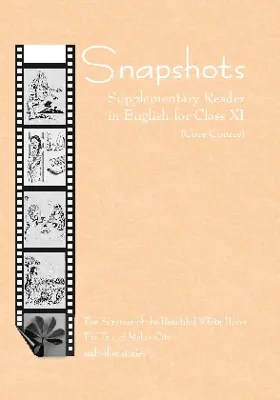
EnglishClass 11

Snapshots

Supplementary Reader5 Chapters

Chapter notes

What you'll learn in Snapshots

A quick revision map of Snapshots — the core idea and five key takeaways from each chapter. Tap any chapter to read the full NCERT PDF and detailed notes.

01

The Summer of the Beautiful White Horse

Chapter 1 of NCERT Class 11 English (Snapshots), "The Summer of the Beautiful White Horse" by William Saroyan, tells the story of two poor Armenian cousins, Mourad and Aram of the Garoghlanian family, who secretly ride a white horse that Mourad has taken from a farmer named John Byro, and ultimately return it, upholding their tribe's centuries-old reputation for honesty.

  • 1Mourad, 13, wakes Aram, 9, at 4 a.m. with a stolen white horse, inviting him to ride before the world is up
  • 2The Garoghlanian family is poverty-stricken yet famous for eleven centuries of unbroken honesty — no member would steal
  • 3Aram rationalises that riding the horse is not stealing because they never intend to sell it
  • 4The horse belongs to John Byro, an Assyrian farmer who learned Armenian out of loneliness; it was stolen a month earlier and cost him sixty dollars
  • 5Mourad hides the horse in the deserted barn of a farmer named Fetvajian and rides it secretly every morning
02

The Address

Chapter 2 of NCERT Class 11 English (Snapshots), "The Address", is a short story by Marga Minco in which a daughter travels to Number 46, Marconi Street, to retrieve her late mother's belongings that were kept safe by Mrs Dorling during the War, only to decide she must forget the address and leave the past behind.

  • 1The narrator is the daughter of a Jewish woman ('Mrs S') who lived in Holland; she makes two post-war visits to Number 46, Marconi Street to find her mother's belongings.
  • 2Mrs Dorling is an old acquaintance of the narrator's mother who, during the first half of the War, repeatedly came and carried away silver, antique plates, large vases, crockery, and other valuables, claiming she wanted to save them.
  • 3The address — Number 46, Marconi Street — is central to the story; the narrator's mother told her to remember it, and it represents both hope of retrieval and a link to the past.
  • 4On the second visit, the narrator recognises her mother's possessions (the woollen tablecloth with a burn mark, the silver cutlery, antique plates on the wall, a white tea pot with a gold-bordered lid, a still life of an apple on a pewter plate) but feels oppressed seeing them in the alien, tasteless surroundings of Mrs Dorling's house.
  • 5The narrator resolves to forget the address because objects severed from their original context and familiar life lose their value when seen in strange surroundings; she also has no space for them in her small rented room.
03

Mother’s Day

Chapter 3 of NCERT Class 11 English (Snapshots), "Mother's Day", is a one-act play by J.B. Priestley that humorously and satirically depicts how Mrs Annie Pearson, a taken-for-granted housewife in a London suburb, finally earns respect from her family after her neighbour Mrs Fitzgerald temporarily swaps personalities with her and firmly puts the family in their place.

  • 1Mrs Annie Pearson is a gentle, apologetic housewife in a London suburb who is consistently taken for granted by her family and struggles to assert herself.
  • 2Mrs Fitzgerald, the neighbour, is an older, strong-willed woman who learnt a personality-swap spell in the East and proposes to inhabit Mrs Pearson's body to confront the family.
  • 3After the spell (spoken as "Arshtatta dum — arshtatta lam — arshtatta lamdumbona"), Mrs Fitzgerald's bold personality takes over Mrs Pearson's body, transforming her into a firm, unflappable woman who refuses to cook or iron on demand.
  • 4Doris (daughter in her early twenties) is upset when tea is not ready and her yellow silk dress is not ironed; Cyril (son, the masculine counterpart of Doris) demands his things be put out; George (husband, about fifty, pompous) is shocked to learn the club calls him "Pompy-ompy Pearson".
  • 5The personality swap is reversed after the real Mrs Pearson (now in Mrs Fitzgerald's body) cannot bear the family's distress; both women return to their own bodies at the small table using the same spell.
04

Birth

Chapter 4 of NCERT Class 11 English (Snapshots), "Birth", is an excerpt from A.J. Cronin's novel The Citadel, following young Dr Andrew Manson who battles through a long, difficult delivery in a Welsh mining town, revives a seemingly stillborn baby boy through relentless effort, and walks away feeling, for the first time, that he has done something truly real as a doctor.

  • 1Dr Andrew Manson, newly out of medical school, is assistant to Dr Edward Page in Blaenelly, a Welsh mining town
  • 2Joe and Susan Morgan have waited nearly twenty years for their first child; Joe waits anxiously outside throughout the night
  • 3After a long, harsh labour from midnight to dawn, the baby boy is born apparently lifeless — a case of asphyxia pallida
  • 4Andrew first saves the critically collapsed Susan with an injection before turning to the baby
  • 5He revives the child by alternating hot and cold water baths and performing manual respiration for over half an hour
05

The Tale of Melon City

Chapter 5 of NCERT Class 11 English (Snapshots), "The Tale of Melon City", is a narrative poem by Vikram Seth about a "just and placid" king whose obsession with justice triggers a comic chain of blame that ends with him being hanged by his own decree, after which an idiot's whim places a melon on the throne — a sharp satire on arbitrary governance and hollow notions of liberty.

  • 1The king is described as "just and placid" — a phrase repeated ironically as his rigid notion of justice drives every absurd decision.
  • 2The arch, built to span the main thoroughfare for public edification, is constructed too low and knocks the crown off the king's head.
  • 3A comic chain of blame passes from the chief builder → workmen → masons → architect, each shifting responsibility to the next.
  • 4The architect reveals the king himself amended the plans, causing the king to seek counsel from the wisest man in the land.
  • 5The wisest man (too old to walk or see) rules the arch must be hanged; a councillor objects that it touched the royal head.

More English books

Want offline access with notes & solutions?

Download CBSE Prepmaster for free — includes NCERT solutions, flashcards, mock tests & more.

Download Free App