EnglishClass 11

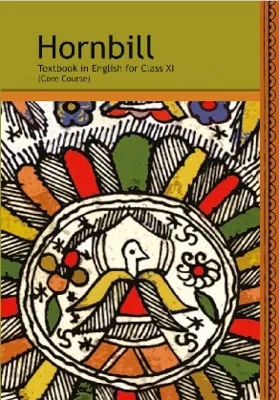
Hornbill

Prose & Poetry7 Chapters

Chapter notes

What you'll learn in Hornbill

A quick revision map of Hornbill — the core idea and five key takeaways from each chapter. Tap any chapter to read the full NCERT PDF and detailed notes.

01

The Portrait of a Lady

Chapter 1 of NCERT Class 11 English (Hornbill), "The Portrait of a Lady", is an autobiographical prose piece by Khushwant Singh that traces the narrator's evolving relationship with his grandmother across three life phases — from childhood in the village, to the city school years, to university and his time abroad — ending with her serene death upon his return.

  • 1Author: Khushwant Singh — autobiographical first-person narrative
  • 2Grandmother described as old, wrinkled, always beautiful — 'like the winter landscape in the mountains, an expanse of pure white serenity'
  • 3Phase 1 (village): inseparable companions — grandmother accompanied narrator to the temple school daily and fed dogs
  • 4Phase 2 (city school): the 'turning-point' — she stopped going to school, disapproved of English science and music lessons, grew distant
  • 5Phase 3 (university): friendship link 'snapped' — she spent days at her spinning-wheel, prayers, and feeding sparrows
02

We’re Not Afraid to Die... if We Can All Be Together

Chapter 2 of NCERT Class 11 English (Hornbill), "We're Not Afraid to Die... if We Can All Be Together", is a first-person survival narrative by Gordon Cook and Alan East about a family's round-the-world voyage on the boat Wavewalker that is struck by a massive wave in the southern Indian Ocean, and how courage, teamwork, and the quiet bravery of two young children carry the crew to safety.

  • 1The narrator and his family depart Plymouth in July 1976 on Wavewalker, a 23-metre, 30-ton wooden boat, to recreate Captain James Cook's round-the-world voyage.
  • 2American Larry Vigil and Swiss Herb Seigler are taken on as crew in Cape Town to help navigate the dangerous southern Indian Ocean.
  • 3On January 2, an enormous wave almost twice the height of other waves strikes the ship, cracking the narrator's ribs, smashing the starboard hull, and flooding the decks.
  • 4The crew works without rest — pumping water, making canvas and timber repairs, and sending unanswered Mayday calls — for over 36 hours to keep the boat afloat.
  • 5Seven-year-old Sue hides a serious head injury (later needing six operations) so as not to distract her father, and makes him a handmade card to boost his spirits.
03

Discovering Tut: the Saga Continues

Chapter 3 of NCERT Class 11 English (Hornbill), "Discovering Tut: the Saga Continues", is a non-fiction piece by A. R. Williams that chronicles the CT scan of King Tutankhamun's mummy on 5 January 2005 and the ongoing quest to solve the mysteries of his life, age at death, and the circumstances of his untimely passing more than 3,300 years ago.

  • 1King Tut's mummy was CT-scanned on 5 January 2005 in the Valley of the Kings, producing 1,700 digital X-ray images in cross section.
  • 2Howard Carter discovered Tut's tomb in 1922 after years of searching; its contents were the richest royal collection ever found.
  • 3Carter's team had to chisel the mummy free from its solid gold coffin because hardened ritual resins had cemented it in place, and they severed nearly every major joint in the process.
  • 4A 1968 X-ray had already revealed that Tut's breastbone and front ribs were missing beneath the resin caking his chest.
  • 5Tut was the last of his family's line; his father or grandfather Amenhotep III was a powerful pharaoh, and his predecessor Akhenaten caused religious upheaval by promoting worship of the sun disk Aten.
04

The Ailing Planet: the Green Movement’s Role

Chapter 4 of NCERT Class 11 English (Hornbill), "The Ailing Planet: the Green Movement's Role", is a non-fiction essay by Nani Palkhivala that argues humanity must shift from a mechanistic to a holistic and ecological view of the Earth, treating the planet as a living organism whose four principal biological systems — fisheries, forests, grasslands, and croplands — are being dangerously depleted by unsustainable human activity and unchecked population growth.

  • 1The Green Movement started nearly twenty-five years before the essay was written; the world's first nationwide Green party was founded in New Zealand in 1972.
  • 2Humanity has shifted from a mechanistic to a holistic and ecological view of the world, recognising the Earth as a living organism with metabolic needs.
  • 3The four principal biological systems identified by Lester R. Brown are fisheries, forests, grasslands, and croplands — they form the foundation of the global economic system.
  • 4Sustainable development was defined by the World Commission on Environment and Development in 1987 as development that meets present needs without compromising future generations' ability to meet their own needs.
  • 5Tropical forests are being lost at forty to fifty million acres a year globally; India alone loses 3.7 million acres of forest annually, with actual loss estimated at eight times the official statistics.
05

The Adventure

Chapter 5 of NCERT Class 11 English (Hornbill), "The Adventure", is a science-fiction story by Jayant Narlikar in which historian Professor Gangadharpant Gaitonde transitions into an alternate India where the Marathas won the Third Battle of Panipat, and his physicist friend Rajendra Deshpande later explains the experience using catastrophe theory and quantum many-worlds thinking.

  • 1Professor Gangadharpant Gaitonde, a historian writing a multi-volume history of India, is the central character who transitions between two worlds.
  • 2The divergence point is the Third Battle of Panipat: in the alternate world, Vishwasrao narrowly escapes the bullet, the Maratha army's morale soars, they rout Abdali, and the East India Company is confined to limited pockets near Bombay, Calcutta, and Madras.
  • 3Gaitonde arrives at a Bombay still flying the Union Jack, with the East India Company headquarters intact and trains bearing 'GBMR' and tiny Union Jack symbols.
  • 4The Bhausahebanchi Bakhar provides material evidence: a torn page describes Vishwasrao's bullet miss, while Gaitonde's own copy records his death — confirming the two histories diverged at that exact moment.
  • 5Rajendra Deshpande's scientific explanation combines catastrophe theory (small changes at critical junctures create radically different outcomes) with quantum many-worlds (reality is not unique; multiple parallel worlds exist and an observer can, under rare circumstances, transition between them).
06

Silk Road

Chapter 6 of NCERT Class 11 English (Hornbill), "Silk Road", is a travelogue by Nick Middleton recounting his journey across the Tibetan plateau toward Mount Kailash to complete the kora, a circumambulatory pilgrimage around the sacred mountain.

  • 1Middleton travels with driver Tsetan and interpreter Daniel from Ravu toward Mount Kailash to complete the kora (a clockwise circumambulation of the sacred mountain).
  • 2The route crosses the Changtang plateau past gazelles, wild ass (kyang), nomadic drokbas, and Tibetan mastiff-guarded tents, over passes reaching 5,515 metres.
  • 3Snow-blocked passes at high altitude require creative driving — spreading soil over ice and negotiating steep rocky slopes in a four-wheel-drive vehicle.
  • 4At Hor on Lake Manasarovar, Daniel leaves; the narrator finds the once-venerated lakeside town grim and littered, a stark contrast to historical travellers' accounts.
  • 5Middleton arrives at Darchen (4,760 m) suffering a cold and acute altitude effects — unable to lie down to sleep, fearing he might not wake up.
07

Note-making and Summarising

Chapter 7 of NCERT Class 11 English (Hornbill), "Note-making and Summarising", is a writing-skills unit that teaches students how to draw out main points from a passage using headings, sub-headings, numbered sections, and abbreviations, and how to convert those notes into a concise summary.

  • 1Note-making is a study and work skill used to draw out main points from material that is too large to remember in full.
  • 2Step-by-step process: underline key words → frame and answer questions → write points in phrase form → group and number → review for sense.
  • 3Good notes are in phrase form only — never full sentences — and identify only the main points.
  • 4Information is logically divided into main sections (1, 2, 3), sub-sections (i, ii, iii) and sub-sub-sections (a, b, c), or alternatively using the decimal system (1, 1.1, 1.1.1).
  • 5Abbreviations, symbols, colons and long dashes are freely used; articles, prepositions and conjunctions are omitted.

More English books

Want offline access with notes & solutions?

Download CBSE Prepmaster for free — includes NCERT solutions, flashcards, mock tests & more.

Download Free App