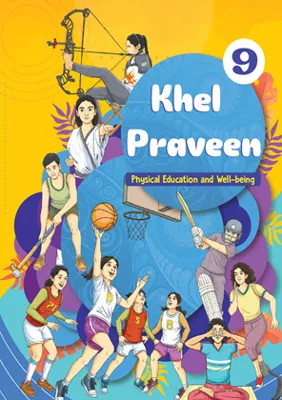
Physical EducationClass 9

Khel Praveen

2026-27 Edition6 Chapters

Chapter notes

What you'll learn in Khel Praveen

A quick revision map of Khel Praveen — the core idea and five key takeaways from each chapter. Tap any chapter to read the full NCERT PDF and detailed notes.

01

Evolution of Physical Education and Well-being

NCERT Class 9 Physical Education Chapter 1 Evolution of Physical Education and Well-being explains physical education as a holistic process of learning through the body — covering its meaning, key definitions, aims, objectives, and the concept of physical literacy with locomotor, non-locomotor, and manipulative movement skills.

  • 1Physical education is a process of learning through the body that trains body and mind together — every sprint, yoga posture, and team game builds life skills alongside physical fitness.
  • 2NCF-SE 2023 names the subject 'Physical Education and Well-being', integrating traditional Indian practices with modern sports to foster overall wellness and personal growth.
  • 3UNESCO's 1978 International Charter calls physical education 'a fundamental right for all' and 'an essential element of lifelong learning that contributes to holistic development, health, and quality of life.'
  • 4Physical literacy is defined as the ability, confidence, and motivation to participate in different physical activities throughout life, analogous to how reading and writing develop language literacy.
  • 5Locomotor skills (walking, jumping, leaping, hopping, skipping) develop strength, speed, agility, and endurance; games like Kabaddi and Kho-Kho depend heavily on them.
02

Science and Sports

NCERT Class 9 Physical Education Chapter 2 Science and Sports covers the scientific study of the human body — anatomy, physiology, the skeletal and muscular systems, the cardiorespiratory system, growth and development, and first aid — showing how each body system supports physical activity and sports performance.

  • 1Anatomy studies the structure of body parts ('what' and 'where'); physiology studies how organs and systems function to maintain life ('how' and 'why').
  • 2Five types of bones: long (e.g., femur), flat (e.g., cranial bones), irregular (e.g., vertebrae), sesamoid (e.g., patella), and short (e.g., carpal bones).
  • 3Joints are classified structurally as fibrous, cartilaginous, or synovial, and functionally as immoveable, slightly moveable, or freely moveable; synovial joints are further divided into ball-and-socket, hinge, pivot, gliding, saddle, and condyloid types.
  • 4Three types of muscles: skeletal (voluntary, attached to bones), smooth (involuntary, found in hollow organ walls), and cardiac (self-stimulating, found only in the heart's myocardium).
  • 5Cellular respiration occurs in the mitochondria — glucose + O₂ produces energy stored as ATP (adenosine triphosphate), with CO₂ and water as waste products; ATP powers all muscle movement and body activities.
03

Olympism

NCERT Class 9 Physical Education Chapter 3 Olympism covers the philosophy, values, history, and symbols of the Olympic Movement, showing how sport promotes peace, unity, and personal excellence. The unit spans Olympic values (Excellence, Friendship, Respect), the Ancient Games from 776 BCE, and the Modern Games revived by Pierre de Coubertin in 1896.

  • 1Olympism is a philosophy of life that balances body, mind, and willpower by combining sport, culture, and education.
  • 2Three core Olympic values: Excellence (giving your best effort), Friendship (trust and mutual respect), and Respect (valuing yourself, others, and the rules).
  • 3Educational values promoted by the Olympic Movement: Joy of Effort, Fair Play, and Balance of Body, Mind, and Willpower.
  • 4The Olympic motto is 'Citius, Altius, Fortius — Communiter' (Faster, Higher, Stronger — Together); 'Together' was added in 2021.
  • 5The five interlaced rings (blue, yellow, black, green, red on white) represent the union of the five continents; designed by Pierre de Coubertin in 1913 and first used at the 1920 Antwerp Games.
04

Sports for All

NCERT Class 9 Physical Education Chapter 4 Sports for All establishes sport as a fundamental human right for everyone regardless of age, gender, ability, or socio-economic background, and explores inclusiveness dimensions, adaptive sports, disability etiquette, the STEP Model, youth athlete health, women in sports, and active ageing.

  • 1'Sports for All' is declared a fundamental right by the 2015 UNESCO International Charter of Physical Education, Physical Activity, and Sport, and the European Sports Charter.
  • 2Ethnosport refers to traditional and indigenous games such as Kabaddi, Kho-Kho, and Mallakhamb that promote cultural heritage and inclusive participation for all communities.
  • 3Five key dimensions of inclusiveness are identified: gender, disability, socio-economic, cultural/ethnic, and age inclusion.
  • 4The STEP Model (Space, Task, Equipment, People) is a practical framework to adapt any activity so that persons with disabilities can participate alongside others.
  • 5The Paralympic Games include 28 sports — 22 summer and 6 winter — and are guided by four core values: Courage, Determination, Inspiration, and Equality.
05

Sports

NCERT Class 9 Physical Education Chapter 5 Sports covers a broad range of physical activities including indigenous Indian martial arts and sports (Thang-Ta, Gatka, Kalaripayattu, Mallakhamb), combat sports (Judo, Wrestling, Taekwondo, Boxing), outdoor team and individual sports (Hockey, Basketball, Cricket, Archery, Softball, Tennis), and foundational activities like Gymnastics and Swimming.

  • 1Gymnastics derived from Greek word 'Gymnos' meaning 'naked art'; Friedrich Ludwig Jahn is the Father of Gymnastics; FIG (founded 1881) governs modern gymnastics; 7 types including Artistic, Rhythmic, Trampoline, Acrobatic, Parkour, Tumbling, and Aerobics.
  • 2Thang-Ta is an indigenous martial art of Manipur (thang = sword, ta = spear); also called Huyen Lallong; basic stance is the Singh Mudra (Lion's Posture); unarmed variant is Sarik Sarat.
  • 3Mallakhamb (Malla = wrestler, Khamb = pole) was revived under Bajirao Peshwa II by Balambhat Dada Deodhar; declared State Sport of Madhya Pradesh in 2013; mentioned in 12th-century Sanskrit text Manasollasa.
  • 4Kalaripayattu (Kerala) is over 3,000 years old; Kalari = training space, Payattu = practising; British banned it; advanced students learn marma-sthānam (vital points of the body).
  • 5Judo originated from Japanese Jiu-Jitsu; first school founded by Prof. Jigoro Kano in 1882; included in Tokyo Olympics 1964; competition held in weight categories.
06

Yoga for Holistic Health and Personal Excellence

NCERT Class 9 Physical Education Chapter 6 Yoga for Holistic Health and Personal Excellence covers Samagra Svāsthya (holistic health and its dimensions), Yogamaya Jīvana (lifestyle factors like diet, sleep, and brahmacharya), and Yoga for Personal Excellence (choosing Śhreyas over Preyas to achieve long-term goals).

  • 1WHO defines health as 'a state of complete physical, mental, and social wellbeing and not merely the absence of disease or infirmity'
  • 2Svāsthya (holistic health) from the Suśhruta-Saṁhitā includes balanced bodily functions, efficient digestion, and a calm self, senses, and mind
  • 3Pañchakośha: five sheaths of existence — Annamaya (physical), Prāṇamaya (life energy), Manomaya (mind), Vijñānamaya (intellect), and Ānandamaya (bliss)
  • 4Āhāra (food) classified as Sāttvika (fresh, nourishing), Rājasika (stimulating), and Tāmasika (stale, heavy) in Bhagavad-Gītā Chapter 17
  • 5Mitāhāra (moderate eating) from Haṭha-Yoga-Pradīpikā: nourishing food leaving one-fourth of the stomach empty

Want offline access with notes & solutions?

Download CBSE Prepmaster for free — includes NCERT solutions, flashcards, mock tests & more.

Download Free App