EnglishClass 8

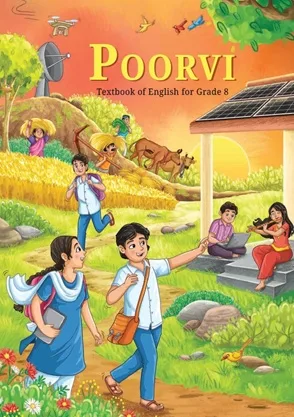
Poorvi

2026-27 Edition5 Chapters

Chapter notes

What you'll learn in Poorvi

A quick revision map of Poorvi — the core idea and five key takeaways from each chapter. Tap any chapter to read the full NCERT PDF and detailed notes.

01

Wit and Wisdom

Unit 1 of NCERT Class 8 English (Poorvi), "Wit and Wisdom", bundles three texts around the theme that cleverness, humour, and keen observation are as valuable as knowledge or strength. The prose story "The Wit that Won Hearts" follows Tenali Ramakrishna, court poet of King Krishnadeva Raya of the Vijayanagara Empire, who uses a paddy-seeds ruse to make the king realise his quarrel with Queen Thirumalambal was caused by a harmless yawn, not disrespect. The poem "A Concrete Example" by Reginald Arkell humorously describes a neighbour's stone-filled garden, ending with the ironic reveal that the speaker had been standing on the very flower they were admiring. The play "Wisdom Paves the Way" shows four young travellers—Ram Datt, Shiv Datt, Har Datt, and Dev Datt—who deduce four facts about a missing camel purely from its tracks, impress the King of Ujjain with their reasoning, and are appointed his royal advisers.

  • 1King Krishnadeva Raya (ruled 1509–29 CE) led the Golden Era of the Vijayanagara Empire; his court included eight celebrated poets called the Ashtadiggajas, among them Tenali Ramakrishna.
  • 2In "The Wit that Won Hearts", Queen Thirumalambal yawned while the king recited his poem late at night; the king mistook this for disrespect and stopped speaking to her for weeks.
  • 3Tenali Rama resolved the quarrel indirectly: in open court he claimed his paddy seeds would fail if sown by someone who yawns—making the king yawn spontaneously and realise that yawning is as natural as breathing.
  • 4The poem "A Concrete Example" by Reginald Arkell uses AABBCC rhyme, a humorous tone, situational irony, alliteration, and a pun in its title (concrete = stone in a garden; concrete = a clear example).
  • 5In the play "Wisdom Paves the Way", Ram Datt deduced lameness from uneven track depth; Shiv Datt deduced right-eye blindness because the camel grazed only left-side foliage; Har Datt deduced a short tail from mosquito-bite blood droplets; Dev Datt deduced stomach pain from the depth of the forefeet prints versus faint hind-foot prints.
02

Values and Dispositions

Unit 2 of NCERT Class 8 English (Poorvi), "Values and Dispositions", bundles three prose and poetry texts that each illustrate a distinct human value: "A Tale of Valour" recounts the courage and sacrifice of Major Somnath Sharma at the Battle of Badgam (1947); "Somebody's Mother" is a poem by Mary Dow Brine about a schoolboy who stops to help an elderly woman cross a snowy street; and "Verghese Kurien — I Too Had A Dream" is a letter by Dr. Verghese Kurien to his grandson Siddharth, sharing the values of integrity, service, and purposeful living that guided his life's work.

  • 1Major Somnath Sharma (1923–1947) was born in Dadh, Kangra, Himachal Pradesh; he trained at Sherwood College, Nainital and the Royal Military College, Sandhurst, and was commissioned into the 19th Hyderabad Regiment in 1942.
  • 2At the Battle of Badgam (3 November 1947), Sharma led D Company — just 90 soldiers — against approximately 500 invaders under Pakistani command; despite a plastered left hand, he insisted on joining his men in combat.
  • 3When ordered to pull back as ammunition ran low, Sharma refused, declaring: "The enemy is only 50 yards from us. We are heavily outnumbered. We are under devastating fire. I shall not withdraw an inch but will fight to the last man and the last round." He was killed moments later by a mortar shell at age 24.
  • 4D Company's resistance bought time for reinforcements to arrive and caused over 300 enemy casualties, including injuring the enemy leader; Major Sharma was posthumously awarded the Param Vir Chakra, India's first recipient of that honour, and his name is inscribed on the Honour Wall of the National War Memorial.
  • 5"Somebody's Mother" by Mary Dow Brine depicts a group of schoolboys who hurry past a frail old woman at a winter crossing; one boy — "the gayest laddie" — stops, whispers "I'll help you cross, if you wish to go," guides her safely across, and returns to his friends reflecting that she is "somebody's mother" and hoping someone would do the same for his own mother.
03

Mystery and Magic

Unit 3 of NCERT Class 8 English (Poorvi), "Mystery and Magic", contains three texts: a detective story "The Case of the Fifth Word" featuring the boy genius Encyclopedia Brown, a narrative poem "The Magic Brush of Dreams" adapted from a folk tale about a girl named Gopi who uses a magic paintbrush to help the poor, and a descriptive essay "Spectacular Wonders" exploring seven mystifying natural phenomena across India. The unit is part of the NEP 2020-aligned Poorvi textbook (Reprint 2026-27).

  • 1"The Case of the Fifth Word" is adapted from Donald J. Sobol's Encyclopedia Brown series; the protagonist Leroy Brown, nicknamed Encyclopedia, helps his father Chief Brown solve crimes that stump the police.
  • 2The stolen jewellery in the story — worth a million dollars — was taken from the Diamond Mart on Sixth Avenue by two masked men; suspects were Tim Nolan and Daniel Davenport, who met while in prison in South Carolina.
  • 3Nolan's dying code used four words — Nom, Utes, Sweden, Hurts — which stand for Monday, Tuesday, Wednesday, and Thursday (each formed by dropping the letters d-a-y); the unwritten fifth word was Fir (Friday), and the jewellery was hidden under a young fir tree in a twenty-gallon jug of earth at Nolan's palm-tree nursery.
  • 4"The Magic Brush of Dreams" is a narrative poem (ballad) adapted from a folk tale; Gopi is instructed by a mysterious man to use the magic brush only for the poor, not the wealthy; she defies the Zamindar's orders, is imprisoned, and escapes by painting a road and a horse.
  • 5Gopi defeats the Zamindar by painting a mighty river that blocks his pursuit, then threatens to paint a beast to chase him away, forcing him to flee.
04

Environment

Unit 4 of NCERT Class 8 English (Poorvi), "Environment", bundles three texts around humanity's relationship with the natural world: the short story "The Cherry Tree" by Ruskin Bond, the poem "Harvest Hymn" by Sarojini Naidu, and the short story "Waiting for the Rain" by Kamakshi Balasubramanian. Together they explore nurturing nature, gratitude for the harvest, and trusting the land's own rhythms.

  • 1"The Cherry Tree" by Ruskin Bond traces the growth of a cherry tree from a single seed Rakesh plants in the soft corner of his grandfather's garden in the Himalayan foothills near Mussoorie, following it through several monsoons, a goat attack, and a scythe blow before it blossoms and bears fruit.
  • 2Grandfather's advice — "Nothing is lucky if you put it away; if you want luck, you must put it to some use" — drives Rakesh to plant the seed rather than merely keep it.
  • 3"Harvest Hymn" by Sarojini Naidu is structured in four stanzas sung by Men's Voices (praising Surya), Men's Voices again (praising Varuna), Women's Voices (praising Prithvi), and All Voices together (praising Brahma), using cymbal, flute, pipe, drum, and prayer as offerings.
  • 4In "Waiting for the Rain" by Kamakshi Balasubramanian, farmer Velu cultivates jowar and dhal on his own land for six years until an unprecedented drought forces his fields to lie untended, cracked, and bare.
  • 5An old woman under a shady tree tells Velu that Nature, like a mother, gives the earth the rest it needs — the drought is the land's chance to lie undisturbed and recover before springing back into activity.
05

Science and Curiosity

Unit 5 of NCERT Class 8 English (Poorvi), "Science and Curiosity", brings together three texts united by a sense of wonder at the natural and scientific world: the science-fiction story "Feathered Friend" by Arthur C. Clarke, in which a canary smuggled aboard a space station ends up saving the crew's lives; the poem "Magnifying Glass" by Walter de la Mare, which celebrates the power of a lens to reveal hidden marvels in ordinary things; and a biographical article on Bibha Chowdhuri, India's first woman physicist, tracing her pioneering work on cosmic rays and pi-mesons and her quiet legacy that inspired generations of women in Indian science.

  • 1"Feathered Friend" by Arthur C. Clarke is a science-fiction story in which space-station construction worker Sven Olsen smuggles a yellow canary named Claribel aboard, partly out of scientific curiosity to see how a bird behaves in the absence of gravity.
  • 2Claribel quickly adapts to weightlessness, performing backward loops and flying with minimal effort; she becomes a general pet loved by the whole crew.
  • 3When a rare eclipse causes part of the air purifier to freeze and the single alarm circuit fails, Claribel collapses—alerting the narrator, who recalls the mining tradition of using canaries to detect dangerous gas, saving the crew from suffocation.
  • 4Walter de la Mare's poem "Magnifying Glass" shows how a round glass reveals a myriad of shells in a scrap of chalk, a forest in an inch of moss, a hive of bees in a drop of water, and the intricate spinning of a spider's web from its spinnerets, ending with the idea that similar lenses make the moon seem reachable in an afternoon.
  • 5The biographical essay on Bibha Chowdhuri, born in Kolkata in 1913, traces how she became India's first woman physicist, earned her Ph.D. on cosmic rays at the University of Manchester under Nobel Laureate Patrick M. S. Blackett, and discovered pi-mesons—a subatomic particle.

More English books

Want offline access with notes & solutions?

Download CBSE Prepmaster for free — includes NCERT solutions, flashcards, mock tests & more.

Download Free App