Social ScienceClass 8

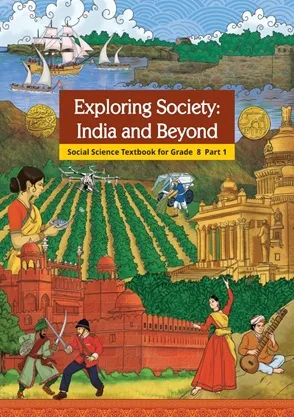
Exploring Society: India and Beyond

2026-27 Edition (Part 1)7 Chapters

Chapter notes

What you'll learn in Exploring Society: India and Beyond

A quick revision map of Exploring Society: India and Beyond — the core idea and five key takeaways from each chapter. Tap any chapter to read the full NCERT PDF and detailed notes.

01

Natural Resources and Their Use

Natural resources are materials and substances that occur in Nature and are valuable to humans; they are classified as renewable (solar energy, wind, flowing water, timber) or non-renewable (coal, petroleum, iron, copper, gold), and their uneven distribution shapes trade, settlements, and conflicts.

  • 1An entity from Nature becomes a resource only when it is technologically accessible, economically feasible, and culturally acceptable.
  • 2Resources are categorised by use: essential for life (air, water, soil), sources of materials (wood, marble, coal, gold), and sources of energy (coal, petroleum, natural gas, sunlight, wind).
  • 3Renewable resources such as solar energy, wind, flowing water, and timber can regenerate if harvested at a sustainable rate; over-harvesting can turn them effectively non-renewable.
  • 4Non-renewable resources—coal, petroleum, iron, copper, and gold—are formed over long periods and cannot be replenished at the rate of use; India's coal reserves are estimated to last about 50 more years.
  • 5Natural resources are unevenly distributed, shaping settlements, trade, and conflicts; Kaveri River water-sharing among Karnataka, Tamil Nadu, Kerala, and Puducherry is one example.
02

Reshaping India's Political Map

Chapter 2 of Exploring Society: India and Beyond (Class 8) traces how India's political map was reshaped from the 13th to 17th centuries through the rise and fall of the Delhi Sultanate, the Mughal Empire, and regional powers such as the Vijayanagara Empire, the Rajputs, the Ahoms, and the Sikhs.

  • 1The Delhi Sultanate (established 1206) was ruled by five successive Turkic-Afghan dynasties — Mamluks, Khiljis, Tughlaqs, Sayyids, and Lodis — with an average sultan's reign of only about nine years due to violent successions.
  • 2Muhammad bin Tughlaq moved his capital from Delhi to Daulatabad (over 1,000 km) and introduced token copper currency in place of silver and gold, both of which failed and caused great loss of life and economic decline.
  • 3The Vijayanagara Empire, founded at Hampi (present-day Karnataka) by brothers Harihara and Bukka, reached its peak under Krishnadevaraya in the 16th century; he composed the Telugu epic Amuktamalyada and patronised poets in Sanskrit, Telugu, and Kannada.
  • 4Babur established the Mughal Empire after defeating Ibrahim Lodi at the First Battle of Panipat in 1526, relying heavily on gunpowder, field artillery, and matchlock guns — weapons recently introduced in warfare in India.
  • 5Akbar abolished the jizya tax on non-Muslims, promoted the doctrine of sulh-i-kul (tolerance of all faiths), and established a 'house of translation' at Fatehpur Sikri where major Sanskrit texts including the Mahabharata and Ramayana were translated into Persian.
03

The Rise of the Marathas

The Marathas were a people of the Deccan plateau (present-day Maharashtra) who, under Chhatrapati Shivaji Maharaj from 1646, built India's largest empire before the British — defeating the Mughals, establishing a dedicated navy, and governing through an efficient centralised administration rooted in the ideal of Swarājya (self-rule).

  • 1Chhatrapati Shivaji was born in 1630 in the Bhonsle clan; he began military campaigns at 16, founded the Maratha Navy in 1657, and was crowned Chhatrapati at Raigad fort in 1674 with the title 'Shri Raja Shiva Chhatrapati'.
  • 2Guerrilla warfare and fort-based strategy were the core Maratha military tactics — Ramachandrapant Amatya's Ādnyāpatra (1715) called forts 'the core of the state'; Kanhoji Angre later secured naval supremacy despite technologically superior European ships.
  • 3Shivaji's administration abolished hereditary posts, paid every official a salary from the state treasury, periodically transferred officials, and provided pensions to widows of soldiers killed in battle.
  • 4The ashta pradhana mandala (council of eight ministers) assisted Shivaji with administration, covering roles from prime minister (Pradhān) to commander-in-chief (Senāpati) and foreign affairs minister (Sumant).
  • 5The Marathas levied chauth (25 per cent) and sardeshmukhi (an additional 10 per cent) from provinces not directly under them as a protection tax; the Mughals approved this arrangement through treaties.
04

The Colonial Era in India

Chapter 4 of Class 8 Social Science traces how European powers — Portuguese, Dutch, French, and British — arrived in India from 1498 onward, and how the British came to dominate the subcontinent for nearly two centuries through military conquest, economic exploitation, and political manipulation, drastically reducing India from one of the world's richest countries to one of the poorest.

  • 1India contributed at least one-fourth of world GDP (per economist Angus Maddison) until the 16th century; this wealth attracted European colonial powers.
  • 2Vasco da Gama reached Kappad near Kozhikode in May 1498; the Portuguese controlled the spice trade using the cartaz (pass) system and established the Goa Inquisition in 1560 (abolished only in 1812).
  • 3The Dutch were decisively defeated at the Battle of Colachel in 1741 by Travancore's King Marthanda Varma — a rare instance of an Asian power successfully repelling a European colonial force.
  • 4The British East India Company employed 'divide and rule,' the Doctrine of Lapse (annexing states with no male heir), and subsidiary alliances (first entered by the ruler of Hyderabad in 1798) to expand control without costly direct wars.
  • 5The Bengal Famine of 1770–1772 killed an estimated 10 million people (about one-third of Bengal's population) as the Company maintained and even increased land tax; total famine deaths under British rule are estimated at 50–100 million.
05

Universal Franchise and India's Electoral System

Universal adult franchise means every Indian citizen aged 18 and above has the right to vote — one person, one vote of equal value — irrespective of caste, religion, gender, education, or income (Article 326). India's elections are managed by the Election Commission of India, which conducts Lok Sabha, state assembly, Rajya Sabha, and presidential elections.

  • 1Universal adult franchise guarantees every citizen aged 18 and above one equal vote regardless of caste, creed, race, religion, gender, education, or income; governed by Article 326 of the Constitution.
  • 2India lowered the voting age from 21 to 18 in 1988; before Independence only 13 per cent of Indians were allowed to vote.
  • 3The Election Commission of India (ECI), established in 1950, sets election dates, registers political parties, enforces the Model Code of Conduct, and oversees all elections including those for the President and Vice President.
  • 4The 2024 Lok Sabha elections covered 543 constituencies (84 reserved for SCs, 47 for STs) with about 980 million eligible voters and over 1 million polling stations.
  • 5India uses the First-Past-the-Post system — the candidate with the most votes in a constituency wins even without securing 50 per cent of total votes.
06

The Parliamentary System: Legislature and Executive

India's Parliament is composed of the President, the Lok Sabha (House of the People), and the Rajya Sabha (Council of States), forming a bicameral legislature that makes laws and holds the executive accountable. The Prime Minister and Council of Ministers form the Union Executive, which implements laws and runs the government.

  • 1Indian Parliament is bicameral — the Lok Sabha (lower house, maximum 550 members, directly elected by citizens) and the Rajya Sabha (upper house, members elected indirectly by an electoral college).
  • 2The 18th Lok Sabha was constituted in June 2024; there have been 17 Lok Sabhas since the first in 1952.
  • 3Parliament's four legislative functions are: constitutional functions, lawmaking, executive accountability, and financial accountability.
  • 4A bill becomes law through introduction in either house, referral to a Standing Committee, clause-by-clause discussion, passing in both houses, Presidential assent, and Gazette notification.
  • 5Question Hour is typically the first hour of a Parliamentary session, during which MPs question ministers about government policies and decisions.
07

Factors of Production

Factors of production are the resources or inputs used to produce goods and services, classified in economics into four types: land (natural resources), labour (physical and mental effort), capital (monetary resources and durable assets), and entrepreneurship; technology acts as a key enabler of production.

  • 1Four factors of production: land (natural resources), labour, capital, and entrepreneurship; technology is described as a crucial facilitator — not a factor itself — that enables businesses to produce more with the same or fewer inputs.
  • 2In economics, 'land' encompasses not just geographical land but also natural resources including soil, forests, water, air, sunlight, minerals, oil, and natural gas.
  • 3Labour refers to physical and mental effort used in production; human capital is distinct — it refers to the specialised skills, knowledge, abilities, and expertise that determine the quality and efficiency of that labour.
  • 4Facilitators of human capital are education and training, good healthcare (which supports cognitive development and productivity), and social/cultural influences — such as Japan's kaizen ('continuous improvement') concept applied since the mid-1940s.
  • 5Capital includes monetary resources and durable human-made assets such as machinery, tools, equipment, vehicles, computers, shops, and factory buildings; businesses raise capital through personal savings, bank loans (paying interest), or the stock market (issuing shares and paying dividends).

More Social Science books

Want offline access with notes & solutions?

Download CBSE Prepmaster for free — includes NCERT solutions, flashcards, mock tests & more.

Download Free App