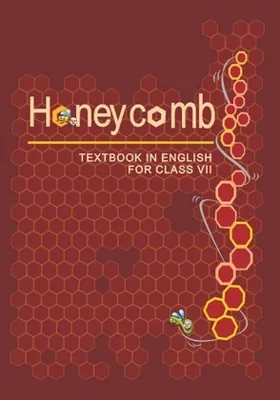
EnglishClass 7

Honeycomb

English Textbook8 Chapters

Chapter notes

What you'll learn in Honeycomb

A quick revision map of Honeycomb — the core idea and five key takeaways from each chapter. Tap any chapter to read the full NCERT PDF and detailed notes.

01

Three Questions

Chapter 1 of NCERT Class 7 English (Honeycomb), "Three Questions", is a story retold from Leo Tolstoy. A king believes he will never fail if he knows three things: the right time to begin something, the people he should listen to, and the most important thing to do. Unable to find satisfying answers from wise men, he visits a hermit. Through events that unfold at the hermit's hut — digging the garden, saving a wounded enemy — the king receives his answers through lived experience rather than advice.

  • 1The king's three questions are: What is the right time to begin something? Who are the people he needs most? What is the most important thing to do?
  • 2Many wise men gave different answers — some advised a timetable, others a council of wise men, others said magicians could tell the right time — but none satisfied the king, so no reward was given.
  • 3The king disguised himself in ordinary clothes and went alone to the hermit's hut in the forest, leaving his bodyguard and horse behind.
  • 4The king helped the hermit dig garden beds and, when a bearded man came running with a stomach wound, the king washed and dressed his wounds through the night until the bleeding stopped.
  • 5The wounded man revealed he was the king's enemy, had planned to kill him, but was wounded by the king's bodyguard; saved by the king, he asked forgiveness and swore lifelong loyalty.
02

A Gift of Chappals

Chapter 2 of NCERT Class 7 English (Honeycomb), "A Gift of Chappals", is a short story by Vasantha Surya about a young girl named Mridu who visits her cousins Ravi, Meena, and Lalli in Madras. The children secretly shelter a stray kitten named Mahendravarma Pallava Poonai. When a barefoot beggar arrives at the door, the kind-hearted children give away the music-master's brand-new chappals to protect his blistered feet, setting off a comic and touching chain of events that ends with Rukku Manni replacing the chappals from Gopu Mama's wardrobe.

  • 1Mridu is a young girl from Madras who visits her aunt Rukku Manni's house and meets her cousins Ravi, Meena, and Lalli.
  • 2The children secretly keep a stray kitten named Mahendravarma Pallava Poonai (M.P. Poonai), hidden behind a bitter-berry bush, and struggle to smuggle milk past their grandmother.
  • 3Ravi spins an elaborate story claiming the kitten is descended from the ancient Pallava dynasty's lion emblem and even the Egyptian cat-goddess Bastet.
  • 4Lalli's painful attempts to learn the violin from a music-master provide comic contrast — her playing startles the kitten into a tray of red chillies.
  • 5A regular beggar arrives at the gate with large, pink, blistered feet; Mridu suggests finding him chappals, and Ravi gives him the music-master's brand-new chappals without permission.
03

Gopal and the Hilsa Fish

Chapter 3 of NCERT Class 7 English (Honeycomb), "Gopal and the Hilsa Fish", is a comic-strip story set during hilsa-fish season. The king, tired of everyone talking only about hilsa-fish, challenges his clever courtier Gopal to buy a hilsa-fish without letting anyone — from the market to the palace — speak a single word about it. Gopal accepts the challenge and succeeds through a witty disguise that distracts everyone completely.

  • 1It was the season for hilsa-fish, and fishermen — and everyone else — could think of nothing but hilsa-fish.
  • 2The king, irritated by the constant hilsa-fish talk, challenged Gopal to buy a hilsa-fish without anyone talking about the fish.
  • 3Before going to the market, Gopal half-shaved his face and smeared himself to look comical and shocking.
  • 4Gopal's bizarre appearance caused such a stir that no one paid any attention to the hilsa-fish he was carrying.
  • 5To get into the palace after buying the fish, Gopal created a scene at the gate that compelled the king to summon him.
04

The Ashes that Made Trees Bloom

Chapter 4 of NCERT Class 7 English (Honeycomb), "The Ashes that Made Trees Bloom", is a Japanese folk tale retold by William Elliot Griffis. It contrasts a kind, hardworking old couple and their beloved dog Muko against their cruel, greedy neighbours. Through the dog's spirit — appearing twice in the old man's dreams — the couple regains wealth, restores blossoming trees, and earns royal rewards, while the wicked neighbours suffer for every imitation of those acts.

  • 1The kind old couple in feudal Japan (the era of daimios) own a small dog named Muko, whom they love and pamper like a baby — feeding him fish from their chopsticks and making him a blue crape cushion.
  • 2While the old man farms, the dog follows him daily; one day it whines and scratches the earth, leading the farmer to dig up a pile of gleaming gold that makes the couple wealthy.
  • 3The envious neighbours lure the dog with food, force him to scratch near their pine tree, but find only a dead kitten; in rage they beat the dog to death and bury him under the tree.
  • 4The old man mourns the dog like a child, sets up a grave with flowers, water, food, and incense under the pine tree; that night the dog's spirit appears in a dream, instructing him to cut the tree and make a mortar and hand-mill from it.
  • 5When the old woman uses the mortar and mill, boiled rice turns to gold coins and beans grind down as falling gold; the neighbours borrow these tools but produce only foul worms, so they chop the mill into firewood.
05

Quality

Chapter 5 of NCERT Class 7 English (Honeycomb), "Quality", is a short story by John Galsworthy (simplified and abridged) about Mr Gessler, a German bootmaker in London who devotes his entire life to making perfect boots. The narrator admires Mr Gessler's extraordinary craftsmanship — his boots always fit and lasted far longer than those of any large firm. Unable to advertise or compromise on quality, Mr Gessler slowly loses all his customers to big commercial firms and eventually dies of slow starvation, sitting over his work to the very last.

  • 1Mr Gessler is a German bootmaker settled in London who made boots only to order and whose work always fit perfectly — the narrator calls it 'mysterious and wonderful'.
  • 2His boots lasted 'terribly long', so the narrator could not visit the shop very often — there was no need for new boots.
  • 3When the narrator once entered wearing boots bought at a large firm, Mr Gessler silently pressed the uncomfortable spot and said, 'Those big firms have no self-respect. They get it by advertisement, not by work.'
  • 4Mr Gessler's elder brother dies, and on his next visit the narrator finds Mr Gessler much aged and worn, barely recognising his long-time customer.
  • 5On the narrator's last visit, the shop name is gone; a young English man has taken it over and reveals Mr Gessler is dead — 'slow starvation' according to the doctor.
06

Expert Detectives

Chapter 6 of NCERT Class 7 English (Honeycomb), "Expert Detectives", is a story by Sharada Dwivedi (from The Broken Flute) about two siblings — ten-year-old Maya and her seven-year-old brother Nishad (nicknamed Seven) — who become fascinated by their reclusive neighbour Mr Nath, a gaunt, scarred man living alone in Room 10 of Shankar House. Maya is convinced he is a criminal on the run; Nishad feels sympathy and wants to be his friend. The children gather clues from Ramesh, the restaurant worker who delivers Mr Nath's meals, and Maya compiles a fact-list titled "Catching a Crook" — but the story ends with the two siblings at odds, and Mr Nath's true story left as an open question for the reader.

  • 1Nishad is seven years old and called 'Seven' because his name means the seventh note on the musical scale; his sister Maya is ten years old.
  • 2Mr Nath lives alone in Room 10 of Shankar House, has burn scars on his face, does not work, and receives no letters; other tenants consider him strange and unfriendly.
  • 3Nishad visits Mr Nath, who recognises him ('Lost another marble?'), and Nishad gives him a bar of chocolate out of concern for his gaunt appearance.
  • 4Ramesh, who works at the restaurant downstairs, brings Mr Nath two meals and two cups of tea every day; Mr Nath eats two chapattis, some dal and a vegetable — always the same food — pays cash and tips well.
  • 5Every Sunday, a tall, fair, stout, spectacled man visits Mr Nath for lunch; this visitor talks a lot, unlike Mr Nath who hardly speaks.
07

The Invention of Vita-Wonk

Chapter 7 of NCERT Class 7 English (Honeycomb), "The Invention of Vita-Wonk", is an excerpt from Roald Dahl's Charlie and the Great Glass Elevator. In it, the eccentric inventor Mr Willy Wonka explains to Charlie how he created Vita-Wonk — a potion that rapidly ages a person — after his earlier invention Wonka-Vite (which made people younger) proved dangerously too strong, turning some people's ages into minus numbers.

  • 1Wonka-Vite made people younger but was dangerously strong — one person's age became minus eighty-seven, meaning he had to wait eighty-seven years before he could come back.
  • 2To counteract Wonka-Vite, Mr Wonka invented Vita-Wonk, which makes people rapidly older.
  • 3Wonka's starting question was: what is the oldest living thing in the world? Charlie answered: a tree. Wonka identified the Bristlecone pine on Wheeler Peak, Nevada, which can live over 4,000 years.
  • 4Wonka collected samples from ancient living things including a 4,000-year-old Bristlecone pine, a 168-year-old Russian farmer, a 200-year-old tortoise, a 51-year-old Arabian horse, a 36-year-old cat called Crumpets, a 207-year-old Giant Rat from Tibet, a 97-year-old Grimalkin, and a 700-year-old Cattaloo from Peru.
  • 5He also tracked down fantastical creatures — the Whistle-Pig, the Bobolink, the Skrock, the Pollyfrog, the Giant Curlicue, the Stinging Slug, and the Venomous Squerkle, which can spit poison fifty yards.
08

A Homage to Our Brave Soldiers

Chapter 8 of NCERT Class 7 English (Honeycomb), "A Homage to Our Brave Soldiers", is an exchange of two letters between school friends Soumya (Bengaluru) and Ananda (Chandigarh). Soumya writes on 14 April 2022 about her school educational trip to the National War Memorial in New Delhi, describing its four concentric chakras, the Amar Jawan Jyoti flame, the 29,000 granite tablets bearing over 26,000 fallen soldiers' names, gallantry awards such as the Param Vir Chakra, and the citations of Lance Naik Albert Ekka and Major Padmapani Acharya. Ananda replies on 24 April 2022, sharing a poem by Makhanlal Chaturvedi and expressing her own resolve to honour the soldiers.

  • 1The National War Memorial was constructed between April 2018 and February 2019, inaugurated by Prime Minister Narendra Modi, and is spread over 40 acres near India Gate in New Delhi.
  • 2The memorial has 29,000 tablets (each called a 'tablet', made of granite) on which more than 26,000 names of fallen soldiers have been etched, covering wars from 1947 to date — including the Indo-China conflict of 1962, Indo-Pakistan Wars of 1965 and 1971, and the Kargil War of 1999.
  • 3The memorial's four concentric circles are: Amar Chakra (Circle of Immortality — obelisk with eternal flame), Veerta Chakra (Circle of Bravery — covered gallery with six bronze murals), Tyag Chakra (Circle of Sacrifice — granite-tablet walls of honour with names in golden letters), and Raksha Chakra (Circle of Protection — row of trees symbolising soldiers guarding the nation).
  • 4The Amar Jawan Jyoti, an immortal flame kept burning day and night, originally burned under the arch of India Gate (lit in January 1972 after the 1971 war victory); it is now housed in the obelisk at the memorial, and the old flame was merged with the new flame during inauguration.
  • 5India's highest wartime gallantry award is the Param Vir Chakra (PVC); 21 bravehearts have been awarded it. Other gallantry awards mentioned are Maha Vir Chakra (MVC), Kirti Chakra (KC), Vir Chakra (VrC), and Shaurya Chakra (SC).

More English books

Want offline access with notes & solutions?

Download CBSE Prepmaster for free — includes NCERT solutions, flashcards, mock tests & more.

Download Free App