EnglishClass 6

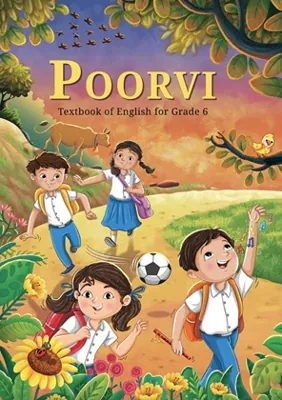
Poorvi

English Textbook5 Chapters

Chapter notes

What you'll learn in Poorvi

A quick revision map of Poorvi — the core idea and five key takeaways from each chapter. Tap any chapter to read the full NCERT PDF and detailed notes.

01

Fables and Folk Tales

Unit 1 of NCERT Class 6 English (Poorvi), "Fables and Folk Tales", contains three texts: the prose fable "A Bottle of Dew" by Sudha Murty, the poem "The Raven and the Fox" by Jean de La Fontaine, and the folk tale "Rama to the Rescue" (adapted from Amar Chitra Katha), all united by the theme of wisdom through wit and the consequences of greed or pride.

  • 1Unit 1 contains three texts: the fable "A Bottle of Dew", the poem "The Raven and the Fox", and the folk tale "Rama to the Rescue"
  • 2"A Bottle of Dew" (Sudha Murty): Rama Natha is tricked by sage Mahipati into growing a banana plantation; he discovers that hard work, not magic, creates wealth
  • 3Madhumati, Rama Natha's wife, sells banana produce at the market and accumulates gold coins, showing the value of partnership and industry
  • 4"The Raven and the Fox" (Jean de La Fontaine): the fox Reynard flatters Mr Raven with praise about his feathers and singing voice, causing the proud raven to open his beak and drop his food
  • 5The poem's moral, stated by the fox himself: pride is unwise and flattery should be ignored
02

Friendship

Unit 2 of NCERT Class 6 English (Poorvi), "Friendship", brings together three texts — the story "The Unlikely Best Friends" (an elephant and a dog who form a cross-species bond), the poem "A Friend's Prayer" by Jill Wolf (a heartfelt prayer for cherishing and supporting one's friends), and the story "The Chair" (in which a boy named Mario uses an invisible magic chair to discover who his true friends really are). Together they explore what genuine friendship means: care, loyalty, and acceptance.

  • 1The unit contains three texts: the prose story "The Unlikely Best Friends", the poem "A Friend's Prayer" by Jill Wolf, and the prose story "The Chair".
  • 2"The Unlikely Best Friends" is rooted in the Jataka tales — ancient Buddhist stories of life values told across generations for over two thousand years.
  • 3Gajaraj the elephant and Buntee the stray dog form a cross-species friendship; when separated, both refuse to eat until they are reunited at the royal stable.
  • 4The poem "A Friend's Prayer" expresses the wish to treat friendship as the most important thing in life, to help friends' wishes come true, and to love friends as they are without judgement.
  • 5In "The Chair", Mario's grandfather gives him an invisible magic chair as a test; only Guneet, Asma, and Deepa hold Mario up when he falls, proving they are his real friends.
03

Nurturing Nature

Unit 3 of NCERT Class 6 English (Poorvi), "Nurturing Nature", bundles three texts that celebrate the natural world: a dialogue called "Neem Baba" in which a girl named Amber learns about the neem tree's history, names, and medicinal and agricultural uses; a four-stanza poem "What a Bird Thought" (Anonymous) that traces a baby bird's growing awareness of the world from eggshell to open sky; and a letter called "Spices that Heal Us" in which a grandmother (Daadi) describes the healing properties of common kitchen spices such as turmeric, fenugreek, ginger, and cardamom.

  • 1"Neem Baba" is adapted from a work by S. I. Farooqi and is written as a dialogue between a girl, Amber, and a personified neem tree she calls Neem Baba.
  • 2The neem tree is described as originating millions of years ago somewhere in North India or Myanmar; its Sanskrit names include Arishta (the one who cures diseases), Nimba, and Nimbaca, while the name 'Neem' was given by Iranians.
  • 3Scientists have called the neem tree 'bitter grace of God', 'nature's gift to man', 'cleanliness-parting tree', 'magic tree', and 'the tree of the twentieth century'.
  • 4Neem leaves, bark, flowers, fruits, and roots can all be used to make medicines; neem seed powder repels locusts, stops mosquito breeding in stagnant water, protects stored grain, and shields crops from termites.
  • 5"What a Bird Thought" is an anonymous four-stanza poem in which a baby bird's understanding of the world grows from the interior of an eggshell to a straw nest with its mother, then to the leaves outside the nest, and finally to the open sky when it flies as an adult.
04

Sports and Wellness

Unit 4 of NCERT Class 6 English (Poorvi), "Sports and Wellness", bundles three texts — the story "Change of Heart", the poem "The Winner" by Georgia Heard, and the informational passage "Yoga – A Way of Life" — around the theme that sports and wellness go far beyond winning or losing.

  • 1"Change of Heart" shows Prabhat's transformation from a win-obsessed player who cheats on the scoreboard to someone who discovers that enjoying a game matters more than the final score.
  • 2Surya, the new student in "Change of Heart", models genuine sporting spirit — relaxed, joyful, and untroubled whether he wins or loses at badminton, basketball, or any other game.
  • 3The poem "The Winner" by Georgia Heard uses personification ('Night wins!') and visual line-break patterns to convey the breathless joy of children playing ball by a creek until dark.
  • 4"Yoga – A Way of Life" explains that yoga originated in ancient India and was systematised by Sage Patanjali in the Yoga Sutras; the word comes from the Sanskrit root 'yuj' meaning 'to join or unite'.
  • 5Yoga's documented benefits include improved flexibility, muscle strength and balance; reduced stress, anxiety and lower back pain; better sleep and concentration; and improved heart health through lower blood pressure.
05

Culture and Tradition

Unit 5 of NCERT Class 6 English (Poorvi), "Culture and Tradition", brings together four thematic texts — "Kalakritiyon ka Bharat" (folk arts of India through the Ek Bharat, Shreshtha Bharat programme), the poem "The Kites" by Daphne Lister, and the biographical passage "Ila Sachani: Embroidering Dreams with her Feet" — to help students explore how India's diverse cultural heritage is expressed through art, craft, poetry, and the spirit of unity in diversity.

  • 1The unit is built around the theme that Bharat's culture is diverse yet united — people live in unison, presenting "unity in diversity" to the world.
  • 2"Kalakritiyon ka Bharat" features four traditional Indian art forms: Aipan (Uttarakhand, white rice flour on geru-red walls), Dhokra (Odisha, 4,000-year-old metal craft using lost-wax casting), coconut shell craft (Kerala, eco-friendly biodegradable household items and jewellery), and Kondapalli toys (Andhra Pradesh, 400-year-old soft wood toys coloured with vegetable dyes).
  • 3The Ek Bharat, Shreshtha Bharat programme aims to enhance interaction and promote mutual understanding between people of different states and UTs through the concept of state/UT pairing.
  • 4The poem "The Kites" by Daphne Lister uses simile, alliteration, and rhyme to express a child's wish to ride a kite and drift on the wind over parks and rooftops.
  • 5Kite-flying is a cultural tradition across India — the International Kite Festival called Uttarayan is celebrated mainly in Gujarat, and the Punjab region celebrates Basant Panchami and Baisakhi by flying kites.

Want offline access with notes & solutions?

Download CBSE Prepmaster for free — includes NCERT solutions, flashcards, mock tests & more.

Download Free App