MathematicsClass 4

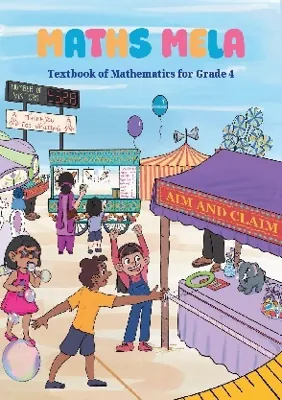
Maths Mela

Mathematics Textbook14 Chapters

Chapter notes

What you'll learn in Maths Mela

A quick revision map of Maths Mela — the core idea and five key takeaways from each chapter. Tap any chapter to read the full NCERT PDF and detailed notes.

01

Shapes Around Us

Chapter 1 of the Class 4 Mathematics NCERT textbook (Maths Mela), "Shapes Around Us", introduces students to 3D solids (prisms, pyramids, cubes, cuboids), angles (right, acute, obtuse), and 2D shapes (triangles, rectangles, circles) through hands-on activities like building models of Delhi monuments, folding nets, and using straws. Download the PDF and explore the chapter summary and Q&A below to prepare confidently.

  • 1Chapter 1 uses Diksha's trip to Delhi monuments (India Gate, Qutub Minar, Akshardham) as the starting context for exploring 3D shapes
  • 2Students build prisms and pyramids from nets provided at the back of the book
  • 3Faces, edges, and corners of 3D shapes are counted and students discover the F + V − E relationship
  • 4Angles are introduced as what forms when two lines meet; right, acute, and obtuse angles are all covered
  • 5Students make a right-angle checker from paper and find right angles on classroom objects
02

Hide and Seek

Chapter 2 of the Class 4 Mathematics NCERT textbook (Maths Mela), "Hide and Seek", introduces young learners to spatial reasoning through the familiar game of hide-and-seek. Children explore top, front, and side views of objects, describe positions using rows and columns on a grid, follow directions on a school map, and play a coordinate-style treasure hunt. Download the PDF to read a full summary and Q&A for this chapter.

  • 1Chapter 2 'Hide and Seek' is from the Class 4 NCERT Maths Mela textbook (2026-27 reprint).
  • 2Students learn to identify top view, front view, and side view of the same 3D object.
  • 3Characters Mini, Bholu, Rani, Jagat, and Gyan appear throughout the chapter's activities.
  • 4A 3x3 grid game uses row-and-column clues to place and locate everyday objects.
  • 5The Treasure Hunt game on a 4x4 grid introduces directed movement (left, right, up, down — no diagonals).
03

Patterns Around Us

Chapter 3 of the Class 4 Mathematics NCERT textbook (Maths Mela), "Patterns Around Us", introduces young learners to counting in groups, recognising number patterns with play money, and discovering odd and even numbers through pairing arrangements. Children count coconut trees, laddoos, and coins, then explore how numbers pair up — or don't — to understand even and odd. Download the PDF and read a summary and Q&A below.

  • 1Chapter 3 teaches counting objects in groups using real-life scenes like coconut trees and laddoo trays
  • 2Play money patterns help students count coin arrangements and make amounts like ₹36, ₹125, and ₹183
  • 3Even numbers can be arranged in pairs with none left over (e.g., 2, 4, 6, 8)
  • 4Odd numbers always have one left unpaired (e.g., 1, 3, 5, 7)
  • 5Students classify numbers from 1 to 100 as odd or even using the pairing method
04

Thousands Around Us

Chapter 4 of the Class 4 Mathematics NCERT textbook (Maths Mela), "Thousands Around Us", introduces students to four-digit numbers using the real-life context of a Gurudwara community lunch (langar) attended by 1,000 people. Students learn the Indian base-10 place value system — Ones, Tens, Hundreds, Thousands — using Dienes Blocks and tokens, then practise comparing, ordering, and writing numbers up to 9,999. Download the PDF and read the full summary and Q&A below.

  • 1The chapter introduces 1,000 (one thousand) as the next unit after Hundreds in the Indian base-10 place value system, shown using Dienes Blocks.
  • 210 Hundreds = 1 Thousand (1000); the pattern mirrors 10 Ones = 1 Ten and 10 Tens = 1 Hundred.
  • 3Four-digit numbers are written in a Th–H–T–O place value table and in expanded form (e.g., 1001 = 1000 + 0 + 0 + 1).
  • 4Arrow cards and token activities let students build and read four-digit numbers up to 9,999 by hand.
  • 5Numbers are compared using < and > by first comparing Thousands digits, then Hundreds, Tens, and Ones.
05

Sharing and Measuring

Chapter 5 of the Class 4 Mathematics NCERT textbook (Maths Mela), "Sharing and Measuring", introduces fractions through hands-on stories and activities — sharing a drawing sheet, dividing dhokla among growing groups of guests, and designing dosas with different toppings. Students discover halves, quarters, thirds, fifths, and beyond, and learn that the more people share a whole, the smaller each part becomes. Download the PDF and read a full summary and Q&A below.

  • 1Half (1/2) means dividing an object into two equal parts; quarter (1/4) means dividing into four equal parts.
  • 2Two quarters of a paper equals one half — students verify this through paper folding.
  • 3As a dhokla is shared among more people (2, 3, 4, 5…), each person's share (unit fraction) gets smaller.
  • 4The chapter uses real-life contexts: drawing sheets, dhokla, dosa toppings, flower gardens, diyas, cookies, and ribbons.
  • 5Fractions of a collection are introduced: for example, 1/4 of 8 diyas = 2 diyas.
06

Measuring Length

Chapter 6 of the Class 4 Mathematics NCERT textbook (Maths Mela), "Measuring Length", introduces students to measuring length using metres and centimetres through hands-on activities like rope-making, long jumps, and treasure hunts, establishes the key relationship 1 m = 100 cm, and extends into finding the perimeter of shapes. Download the PDF and read the summary and Q&A below to prepare for class.

  • 11 metre (m) = 100 centimetres (cm) is the key conversion fact in this chapter
  • 2Half metre = 50 cm and quarter metre = 25 cm, shown using ropes and a number line
  • 3Centimetres are used to measure small objects like erasers, fingernails, ants, and seeds
  • 4Students measure classroom objects using a cm scale and order them by length
  • 5Heights can be written two ways: 120 cm is the same as 1 m 20 cm
07

The Cleanest Village

Chapter 7 of the Class 4 Mathematics NCERT textbook (Maths Mela), "The Cleanest Village", follows students Daisy and Lou on a school trip to Mawlynnong — Asia's Cleanest Village in Meghalaya's East Khasi Hills — weaving real-life addition and subtraction with regrouping through shopping, giving change, puzzle games, and trip arithmetic. Download the PDF and read a summary and Q&A to help your child master 3-digit addition and subtraction with carrying and borrowing.

  • 1Chapter set in Mawlynnong, East Khasi Hills, Meghalaya — described as Asia's Cleanest Village with 77 families and 414 people from the Khasi tribe
  • 2Students Daisy and Lou practice buying vegetables and fruits using a price list (e.g., beans ₹95/kg, banana ₹55/kg, radish ₹23/kg)
  • 3Addition with regrouping taught using Ones-Tens-Hundreds token models; 438 + 476 = 914 children travel to the village
  • 4Subtraction with regrouping (borrowing) demonstrated step by step: 1 Ten regrouped to 10 Ones, 1 Hundred regrouped to 10 Tens
  • 5Change-giving activity: find missing cost, paid amount, or balance across a table of transactions up to ₹500
08

Weigh It, Pour It

Chapter 8 of the Class 4 Mathematics NCERT textbook (Maths Mela), "Weigh It, Pour It", introduces students to measuring weight in grams and kilograms and capacity in millilitres and litres through hands-on activities, real-life stories, and estimation exercises. Students explore how units relate (500 g = ½ kg, 250 ml = ¼ litre) and practise using weighing balances and measuring containers. Download the PDF and read a summary and Q&A below.

  • 1500 g = ½ kg; 250 g = ¼ kg; 100 g = 1/10 kg — core weight equivalences taught in this chapter
  • 21000 ml = 1 litre; 500 ml = ½ litre; 250 ml = ¼ litre — key capacity equivalences
  • 3Estimation is practised before actual measurement using a weighing balance or measuring containers
  • 4The 'Boxes of Sweet' problem (Mr Shrinathan's Kaju-katli) teaches partitioning 1 kg into equal smaller weights
  • 5A matching activity links objects (leaf, pen, cat, tiger, elephant) to weight ranges from 1 g–5 g up to more than 1000 kg
09

Equal Groups

Chapter 9 of the Class 4 Mathematics NCERT textbook (Maths Mela), "Equal Groups", introduces multiplication and division through engaging activities like animal jumps, Gulabo's garden, doubling magic, and real-life word problems involving vehicles, cupcakes, and pottery. Students explore multiples, common multiples, multiplication tables up to 10×10, multiplying by tens and hundreds, and the partial-quotient method for division. Download the PDF and read the summary and Q&A below to master these concepts.

  • 1Multiples of 3, 4, 6, and 8 are explored using frog, squirrel, rabbit, and kangaroo jumps on a number line.
  • 2Common multiples are numbers that two different animals (jump sizes) both land on — e.g., common multiples of 6 and 8 include 24.
  • 3Multiplication is broken into equal groups: multiplier (number of groups) × multiplicand (group size) = product.
  • 4A 10 × 10 multiplication table is built by filling row × column products, and students look for even/odd patterns and repeating ones digits.
  • 5Doubling is used as a multiplication strategy; magician Anvi's trick demonstrates doubling numbers like 23 → 46.
10

Elephants, Tigers, and Leopards

Chapter 10 of the Class 4 Mathematics NCERT textbook (Maths Mela), "Elephants, Tigers, and Leopards", uses real wildlife population data from India — elephants, tigers, and leopards across states like Karnataka, Kerala, Assam, and Madhya Pradesh — to teach 4-digit addition and subtraction with regrouping, estimation, and number patterns. Download the PDF and explore the summary and Q&A below to master every activity in this chapter.

  • 1Uses real wildlife census data — elephants, tigers, leopards — from Indian states to set up word problems
  • 2Teaches 4-digit addition with regrouping using place-value columns (Thousands, Hundreds, Tens, Ones)
  • 3Teaches 4-digit subtraction with regrouping, including borrowing across multiple columns
  • 4Introduces the NIM strategy game: players add 1 or 2 each turn to reach a target number
  • 5Addition chart (0–12) activities build pattern recognition and observation skills
11

Fun with Symmetry

Chapter 11 of the Class 4 Mathematics NCERT textbook (Maths Mela), "Fun with Symmetry", introduces students to lines of symmetry, mirror reflections, and tiling patterns through hands-on activities like ink blot designs, paper aeroplanes, and folding-and-cutting challenges. Students explore symmetry in shapes, numbers, letters, and nature. Download the PDF and read the summary and Q&A below to master every activity in this chapter.

  • 1The ink blot activity: fold paper, add colour drops, press — the result is a symmetrical pattern with a line of symmetry along the fold.
  • 2Paper aeroplane has multiple lines of symmetry; an asymmetrical plane flies differently (and usually worse).
  • 3The line dividing a shape into two equal halves is called the line of symmetry or mirror line / line of reflection.
  • 4Digits with the same mirror image include 0, 1, 8 — used to form mirror-image numbers like 181 and 686.
  • 5Ambulance writes words in mirror script so drivers see them correctly in a rear-view mirror.
12

Ticking Clocks and Turning Calendar

Chapter 12 of the Class 4 Mathematics NCERT textbook (Maths Mela), "Ticking Clocks and Turning Calendar", introduces students to reading time using AM/PM and 24-hour digital clock formats, understanding the relationship between hours and minutes (1 hour = 60 minutes, half hour = 30 minutes, quarter hour = 15 minutes), counting days and weeks on a calendar, and exploring leap years. Download the PDF and read a summary and Q&A below.

  • 1Leap years occur every four years and have 366 days because February has 29 days instead of 28.
  • 2The DD/MM/YYYY date format is used throughout the chapter for writing and reading dates.
  • 3AM stands for the hours from midnight to noon; PM stands from noon to midnight.
  • 424-hour digital clock time runs from 00:00 (midnight) to 23:59 — afternoon hours are simply 12 added to the PM hour.
  • 51 hour = 60 minutes; half an hour = 30 minutes; quarter of an hour = 15 minutes; three-quarters of an hour = 45 minutes.
13

The Transport Museum

Chapter 13 of the Class 4 Mathematics NCERT textbook (Maths Mela), "The Transport Museum", uses a museum visit by Amala, Raahi, and Farzan as the setting to teach multi-digit multiplication and division with remainders. Students learn to multiply by 10s and 100s, construct times-tables by splitting and doubling, and solve real-life word problems involving trains, boats, buses, and aeroplanes. Download the PDF and read a summary and Q&A below to prepare for every activity in this chapter.

  • 1The story follows three children — Amala, Raahi, and Farzan — visiting a Transport Museum that displays modes of transport used in India, including vehicles from olden times.
  • 2The Mystery Matrix activity asks students to find 1-digit multiplicands and multipliers so that row and column products match given numbers.
  • 3Multiplying by 10 is taught as counting Tens: 26 × 10 = 26 Tens = 260; multiplying by 100 is counting Hundreds: 15 × 100 = 15 Hundreds = 1500.
  • 4The times-15 table is constructed by splitting 15 into 10 and 5, computing partial products, and adding — the same strategy used for all tables from 11 to 20.
  • 5Raahi's toy train has 15 coaches each seating 14 children; using grid splitting, students find 15 × 14 = 210 children in all.
14

Data Handling

Chapter 14 of the Class 4 Mathematics NCERT textbook (Maths Mela), "Data Handling", introduces young learners to collecting, organising, and reading data through real-life activities like favourite-subject surveys, colourful ice gola tallies, and a Bal Mela pictograph. Students learn to frame good questions, record responses systematically, fill tables, and compare ways of displaying information. Download the PDF and read the summary and Q&A below to prepare with confidence.

  • 1Students learn to frame a clear single-answer question before collecting data from classmates
  • 245 children's subject preferences (Maths, Languages, The World Around Us, Arts, Physical Education) are recorded using abbreviations and counted
  • 3Children fill in a frequency table and identify the most and least popular subject from the data
  • 4The chapter compares a raw list of responses with an organised table to show why tables are easier to read
  • 5The Colourful Golas activity has students record ice gola colours eaten and compare which colour boys and girls ate most

Want offline access with notes & solutions?

Download CBSE Prepmaster for free — includes NCERT solutions, flashcards, mock tests & more.

Download Free App