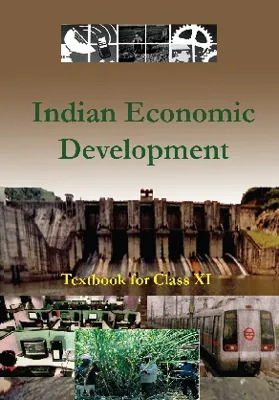
EconomicsClass 11

Indian Economic Development

NCERT Textbook8 Chapters

Chapter notes

What you'll learn in Indian Economic Development

A quick revision map of Indian Economic Development — the core idea and five key takeaways from each chapter. Tap any chapter to read the full NCERT PDF and detailed notes.

01

Indian Economy on the Eve of Independence

This chapter, 'Indian Economy on the Eve of Independence,' examines the state of India's economy in 1947, covering agricultural stagnation, de-industrialisation, foreign trade, demographic conditions, and infrastructure under nearly two centuries of British colonial rule. It explains how colonial policies systematically underdeveloped India to serve Britain's economic interests.

  • 1The sole purpose of British colonial rule was to reduce India to a raw material supplier for Britain's modern industrial base.
  • 2Agriculture was the livelihood of about 85 per cent of India's population, yet the sector experienced stagnation and low productivity due to systems like the zamindari system, where profit went to zamindars rather than cultivators.
  • 3India's world-famous handicraft industries (cotton/silk textiles, metal and precious stone works) declined under colonial rule, with no adequate modern industrial base built to replace them.
  • 4The Tata Iron and Steel Company (TISCO) was incorporated in 1907; cotton mills were concentrated in Maharashtra and Gujarat while jute mills dominated by foreigners were in Bengal.
  • 5Britain maintained monopoly control over India's foreign trade — more than half of India's foreign trade was restricted to Britain; India exported primary products and imported finished goods.

02

Indian Economy 1950–1990

Chapter 2 of Class 11 Indian Economic Development covers India's economic policies from 1950 to 1990, focusing on the goals of Five Year Plans — growth, modernisation, self-reliance, and equity — and the key policy initiatives in agriculture (land reforms, Green Revolution) and industry (IPR 1956, import substitution, licensing system).

  • 1India adopted a mixed economy after 1947, combining private property and democracy with a strong public sector and government planning.
  • 2The Planning Commission was established in 1950 with the Prime Minister as Chairperson; plans were five years long with a longer 'perspective plan' of twenty years.
  • 3The four goals of Five Year Plans were growth (rising GDP), modernisation (new technology and social change), self-reliance (reducing import dependence), and equity (ensuring benefits reach the poor).
  • 4P.C. Mahalanobis, statistician and founder of the Indian Statistical Institute, is regarded as the architect of Indian planning; the Second Five Year Plan was based on his ideas.
  • 5Land reforms — abolition of zamindari intermediaries and land ceiling legislation — aimed to make tillers the owners of land; they succeeded fully only in Kerala and West Bengal.
03

Liberalisation, Privatisation and Globalisation

Chapter 3 of Class 11 Indian Economic Development covers Liberalisation, Privatisation and Globalisation (LPG) — the New Economic Policy introduced in India in 1991 in response to a severe balance of payments crisis. It explains the background of the crisis, the three pillars of reform (liberalisation, privatisation, globalisation), and an appraisal of their impact on different sectors of the Indian economy.

  • 1The 1991 crisis was rooted in India's fiscal mismanagement in the 1980s — government expenditure far exceeded revenue, forex reserves fell to below two weeks of import cover, and no country or institution was willing to lend.
  • 2India borrowed $7 billion from the World Bank and IMF under conditionalities that required liberalisation, reduction of government's role, and removal of trade restrictions — leading to the New Economic Policy (NEP).
  • 3NEP reforms fall under two categories: stabilisation measures (short-term — control inflation and maintain forex reserves) and structural reform measures (long-term — improve efficiency and international competitiveness).
  • 4Liberalisation abolished industrial licensing for almost all products (exceptions: alcohol, cigarettes, hazardous chemicals, industrial explosives, electronics, aerospace, drugs and pharmaceuticals); only atomic energy and some railway activities remain reserved for the public sector.
  • 5Financial sector reforms raised foreign investment limit in banks to around 74 per cent, allowed Foreign Institutional Investors (FIIs) to invest in Indian financial markets, and shifted RBI's role from regulator to facilitator.
04

Human Capital Formation in India

Chapter 4 of Indian Economic Development, titled 'Human Capital Formation in India,' explains how investments in education, health, on-the-job training, migration, and information convert human resources into productive human capital, and analyses India's educational attainment, government spending on education, and the distinction between human capital and human development.

  • 1Human capital is formed through five sources of investment: education, health, on-the-job training, migration, and acquisition of information relating to labour and other markets.
  • 2Unlike physical capital, human capital is inseparable from its owner, creates both private and social (external) benefits, is not perfectly mobile across countries, and depreciates with ageing but can be renewed through continuous investment in education and health.
  • 3Human capital treats people as a means to increase productivity; human development treats people as ends in themselves, where every individual has a right to basic education and a healthy life irrespective of its contribution to output.
  • 4India's literacy rate rose from 16.67% (1951) to 78% (2018-22), and life expectancy at birth for males improved from 37.2 years (1951) to 68.6 years (2018-22), reflecting simultaneous growth across education and health sectors.
  • 5Government education expenditure as a share of GDP increased from 0.64% (1952) to 4.47% (2020), but remains below the 6% of GDP recommended by the Education Commission (1964–66) for a noticeable rate of growth in educational achievements.
05

Rural Development

Chapter 5 — Rural Development — covers the meaning and key challenges of rural development in India, examining rural credit and marketing systems, agricultural diversification into livestock, fisheries and horticulture, and the role of organic farming in achieving sustainable development.

  • 1Rural development is a comprehensive term focused on developing areas that lag behind in the village economy, covering literacy, health, land reforms, infrastructure (credit, marketing, roads, irrigation) and poverty alleviation.
  • 2India adopted social banking and a multi-agency approach after 1969; NABARD was set up in 1982 as the apex body coordinating all rural financing institutions — commercial banks, RRBs, cooperatives and land development banks.
  • 3Self-Help Groups (SHGs) emerged to fill gaps in formal rural credit; by May 2019 nearly 6 crore women had joined 54 lakh women SHGs. Jan-Dhan Yojana led to more than 50 crore bank account openings.
  • 4Agricultural marketing involves assembling, storage, processing, transportation, packaging, grading and distribution; more than 10% of farm produce is wasted due to lack of storage, highlighting the need for better infrastructure.
  • 5Government measures to improve agricultural marketing include regulation of markets, physical infrastructure (warehouses, cold storages), cooperative marketing, MSP, buffer stocks of wheat and rice by the Food Corporation of India, and distribution through the PDS.
06

Employment: Growth, Informalisation and Other Issues

Chapter 6 of Class 11 Indian Economic Development covers employment in India — its growth, informalisation, and key issues including worker categories, sector-wise distribution, types of unemployment, and government employment generation programmes.

  • 1Workers are all persons engaged in economic activities contributing to gross national product, including the self-employed and those temporarily absent from work.
  • 2India had about 545 million workers in 2022-23; men form about 77 per cent of the workforce and rural workers constitute about two-thirds.
  • 3Worker-population ratio for India in 2023-24 was 43.7 overall — 45.6 in rural areas and 38.9 in urban areas; women's ratio (30.7) is much lower than men's (56.4).
  • 4Workers are classified as self-employed (~58%), casual wage labourers (~20%), and regular salaried employees (~22%); self-employment is the largest category.
  • 5Primary sector's share of employment fell from 74.3% in 1972-73 to 46.1% in 2023-24; secondary and service sectors have grown correspondingly.
07

Environment and Sustainable Development

Chapter 7 of Class 11 Indian Economic Development covers Environment and Sustainable Development, explaining the functions of the environment, the state of India's environmental challenges, and strategies to achieve development that meets present needs without compromising future generations.

  • 1Environment is defined as the total planetary inheritance, encompassing all biotic (living) and abiotic (non-living) factors that influence each other.
  • 2The environment performs four functions: supplies resources (renewable and non-renewable), assimilates waste, sustains life through genetic and biodiversity, and provides aesthetic services like scenery.
  • 3Environmental crisis arises when resource extraction exceeds the rate of regeneration and waste generated exceeds the environment's absorptive capacity — its carrying capacity is breached.
  • 4India supports approximately 17% of the world's human population and 20% of livestock on just 2.5% of the world's geographical area, placing enormous pressure on finite natural resources.
  • 5India's five priority environmental concerns are: land degradation, biodiversity loss, vehicular air pollution in urban cities, fresh water management, and solid waste management.
08

Comparative Development Experiences of India and Its Neighbours

Chapter 8 of Class 11 Indian Economic Development compares the developmental strategies and economic indicators of India, China, and Pakistan — three neighbouring countries that began their planned development journeys around the same time but have reached very different outcomes today.

  • 1India and Pakistan became independent in 1947; the People's Republic of China was established in 1949 — all three began planned development at roughly the same time.
  • 2Structural reforms were introduced in China in 1978, in Pakistan in 1988, and in India in 1991; China acted on its own initiative while India and Pakistan were influenced by the World Bank and IMF.
  • 3China's Great Leap Forward (1958) aimed at massive industrialisation through communes, but a severe drought and withdrawal of Soviet professionals caused it to fail, killing about 30 million people.
  • 4China's post-1978 reforms included dividing commune lands into household plots, dual pricing, township and village enterprises, and setting up special economic zones to attract foreign investment.
  • 5China has the second-largest GDP (PPP) at $35 trillion; India's is $15 trillion and Pakistan's is $1.5 trillion (roughly 10% of India's GDP).

More Economics books

Want offline access with notes & solutions?

Download CBSE Prepmaster for free — includes NCERT solutions, flashcards, mock tests & more.

Download Free App